
My favorite place to learn Full stack AI Engineering for Senior Software Engineers
Hello friends, for last 2 years, I’ve been searching for the perfect AI Engineering course for senior developers.
Not the beginner courses that teach basic concepts. Not the academic resources that are more theory than practice. I wanted something built specifically for senior developers who already know how to code, understand architecture fundamentals, and want to genuinely master AI at an expert level.
After testing 15+ AI engineering courses, bootcamps, and platforms, I finally found something that actually works for senior developers transitioning into AI.
Most courses are designed for complete beginners or junior engineers. They hand-hold you through basics, explain every concept twice, and move at a glacial pace.
Senior developers don’t need that.
You’ve already shipped production code. You understand architecture. You know how to debug. You don’t need someone explaining what a variable is.
What you need is a structured path into AI that respects your existing skills while teaching you what you genuinely don’t know — LLMs, RAG systems, agentic frameworks, deployment at scale.
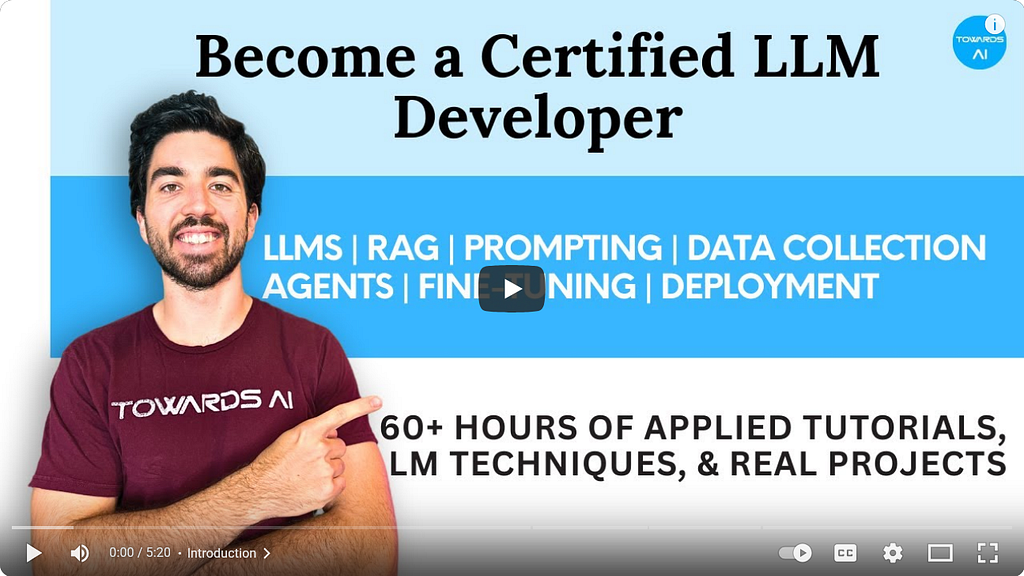
After months of searching, I found exactly that in the Full Stack AI Engineering Course by Towards AI.
Build Real Products with LLMs, Context Engineering, RAG.
And honestly? It’s exceptional.
Why This AI Engineering Course Stands Out (Even Among 15+ Alternatives)
Here’s what I tested:
- Generic Udemy AI courses (too basic for experienced engineers)
- Specialized LLM bootcamps (good but fragmented)
- AI engineering programs on Coursera (academic, slow)
- Hands-on AI workshops (expensive, inconsistent quality)
- Self-study with papers and blogs (scattered, no structure)
Most had the same problem: They treat all learners as blank slates.
The Towards AI Full Stack AI Engineering course assumes something different. It assumes you’re already competent as an engineer. It just needs to teach you AI-specific skills.
That’s the game-changer.
What Makes It Perfect for Senior Developers?
Here are few things which makes this AI engineering course perfect for senior developers who wants to get into field of AI:
1. Built for People Who Know How to Ship Code
This course doesn’t waste time on “here’s what a function is.” Instead, it jumps straight into:
- Building production-grade AI systems
- Real architecture decisions (not toy problems)
- Deployment considerations from day one
- Performance and scale from the start
If you’ve shipped microservices, dealt with infrastructure, or optimized databases, you’ll recognize the thinking immediately.
2. Project-Based Learning (Not Tutorial Hell)
Instead of watching 50 hours of videos, you build one ambitious project: an AI tutor system.
But here’s what’s brilliant: This project requires you to master the complete AI stack:
- Data engineering: Collecting and parsing real data
- Prompt engineering: Context windows, token optimization, advanced prompting techniques
- RAG pipelines: Retrieval-Augmented Generation for grounded AI
- Fine-tuning: When and how to customize models
- Deployment: Actually shipping this to users with Gradio, OpenAI APIs, LlamaIndex
- Monitoring: Keeping it running in production
By the end, you have a working product — not a certificate, not a portfolio piece, but something you could actually launch or pitch to investors.
For senior developers, this is exactly right. You learn by building, just like you always have.
3. Respects Your Time Constraints
Senior developers often can’t commit to 6-month bootcamps or weekly cohorts. You need flexibility.
This course is self-paced. Work whenever you want. The 50+ hours can be spread over 2 weeks or 3 months — your choice.
Plus, every lesson comes with ready-to-run Jupyter notebooks. You’re not debugging environments or environment setup. You can get productive immediately.
4. Stays Current (Weekly Updates)
AI is evolving weekly. New models drop constantly. New tools emerge.
Most courses become stale in 6 months. This one is updated every week with new techniques, tools, and best practices.
When GPT-5 launches, when new vector databases emerge, when new frameworks become standard — this course reflects those changes.
For a senior developer investing time and money, this is crucial. You’re not learning yesterday’s best practices.
5. Real Mentorship and Community
Unlike passive video platforms, you get:
- VIP access to Towards AI’s Slack community — Real engineers answering questions
- Direct instructor mentorship — Actual feedback on your project
- Peer support — 200+ other professionals doing the same thing
- Career guidance — Not just “learn this,” but “here’s how senior engineers approach AI”
For someone transitioning from senior engineer to senior AI engineer, this support matters more than you’d think.
if you already fall in love, here is the link to explore — Full Stack AI Engineering course
What You Actually Get?
Here are things you will get when you join Towards AI, one of the specialized platform for AI and Agentic AI learning.
The Course Itself
Topics Covered:
- Fundamentals of LLMs and transformers (but fast — assumes math background)
- Prompt engineering at scale (not basic prompting)
- Retrieval-Augmented Generation (RAG) architecture and implementation
- Fine-tuning and adaptation (when and why)
- Deployment strategies for production
- Cost optimization (important when paying for API calls)
- Monitoring and evaluation
- Building with multiple AI models (OpenAI, open-source, etc.)
- Using frameworks: LlamaIndex, LangChain, Gradio
The Project
You build an AI tutor covering:
- Ingesting educational materials
- Creating RAG pipelines for knowledge retrieval
- Fine-tuning for domain-specific knowledge
- Deploying for real users
- Monitoring performance
This project lives on your GitHub. You can show it to employers. You can pitch it as a startup. You can build on it post-course.
The Credential
You get a Towards AI certification signifying you’ve built real AI products. Not a participation trophy — evidence you can ship.
The Ongoing Access
Course updates? Included. New lessons on new tools? You get them. New frameworks? Explained.
This is a “living resource” that evolves with the field.
They are now also offering big discount and you can get their lifetime membership for just $349, great time to join the platform.
Honest Assessment: Who This Is (and Isn’t) For
This Full stack AI engineering course is
Perfect for:
- Senior software engineers transitioning into AI
- Experienced developers wanting to build LLM products
- Engineering leaders understanding AI systems
- Architects designing AI infrastructure
- Technical co-founders building AI startups
- ML engineers wanting to move from research to production
Maybe not ideal if:
- You’re a complete programming beginner (take Python courses first)
- You have zero coding experience (self-select for Python fundamentals)
- You want a quick 1–2 hour crash course (this is 50+ hours)
- You prefer self-directed learning without community (this is quite structured)
But honestly? For senior developers specifically, the fit is nearly perfect.
The Cost Question (And Why It’s Actually a Steal)
Price: $349 (discounted from $1000)
“That’s expensive compared to Udemy,” you might think.
But let’s do the math as a senior engineer:
Equivalent options:
- 1:1 mentorship from an AI engineer: $100–150/hour minimum
- This course: 50+ hours with mentorship = ~$7/hour of guided learning
- AI bootcamp: $5K-15K for comparable content
- Self-study + papers: Free but might take 200 hours of scattered learning
ROI perspective:
- If this helps you land one AI engineering role, you make back the cost in a single interview process improvement
- If it helps you build a side project that generates revenue, it pays for itself immediately
- If it accelerates your transition timeline by even 2 weeks, the hourly rate is incredible
For a senior engineer, $349 to systematically learn a rapidly-growing, lucrative skillset? That’s not an expense — it’s an investment that pays immediate dividends.
Here is the link to join this course — Full Stack AI Engineering course
My recommendation for senior developers?
Start with Full Stack AI Engineering. It’s the sweet spot — comprehensive enough to cover everything you need, but respecting your existing expertise.
If you want to go deeper into production scaling afterward, Building LLMs for Production is the natural next step.
Or if you want everything, grab Get It All: From Novice to Expert Bundle — More cost-effective if you’re planning multiple courses.
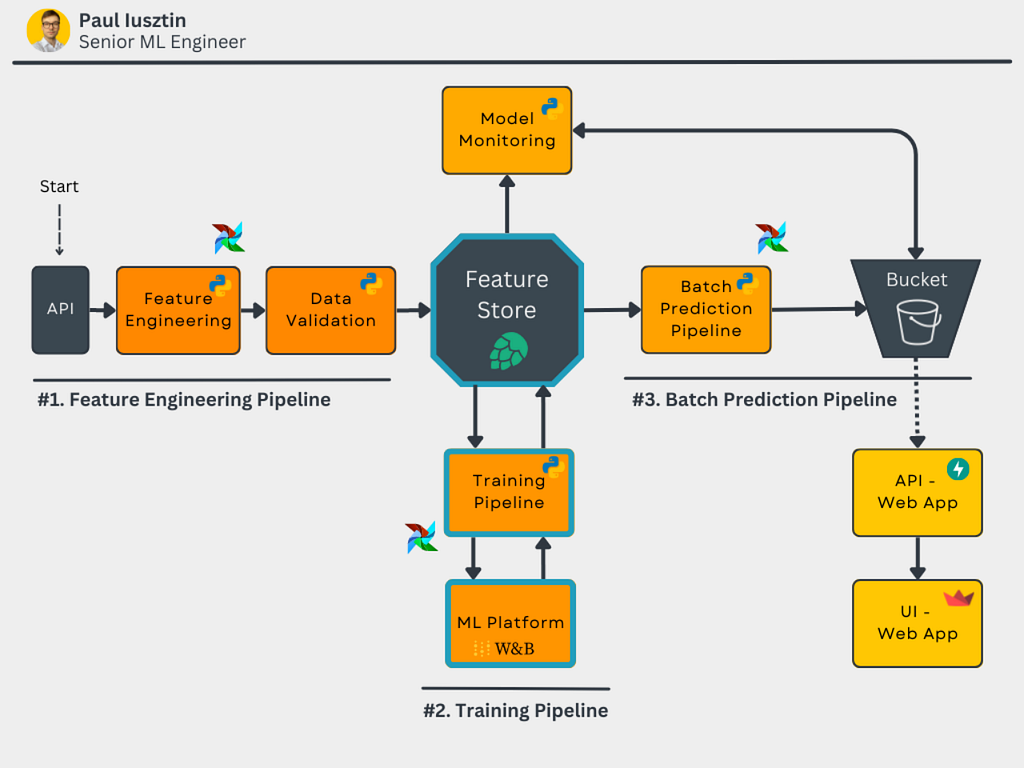
And, if you want to master Agentic AI then Paul Iustzin’s Agentic AI Engineering course is perfect.
Production AI Agents Course: Learn Agent Engineering
What Actually Impressed Me Most?
After years testing educational platforms, here’s what stood out:
- Respect for the learner’s time. No fluff. No “let me explain this concept again.” Just the information you need.
- Real projects, not toy examples. You’re not building the 50th todo app. You’re building something you could actually sell or use.
- Practical over theoretical. Yes, you understand transformers. But more importantly, you know when to use fine-tuning vs. RAG vs. vanilla LLM calls. You understand cost trade-offs.
- Honesty about prerequisites. The course says “requires intermediate Python and GitHub familiarity.” They mean it. No hand-holding for basics, which is perfect for senior devs but would frustrate beginners.
- Living resource. The material updates weekly. I watched new lessons on new tools appear within days of major releases. That’s commitment to currency.
The Bottom Line
I set out to find “the best AI course for senior developers.”
After testing 15+ alternatives, I found it in the Full Stack AI Engineering Course by Towards AI.
Build Real Products with LLMs, Context Engineering, RAG.
It’s the right level (respects your existing expertise), the right pace (efficient, no fluff), the right approach (project-based), the right community (real mentorship), and the right price (investment, not expense).
For a senior software engineer, machine learning engineer, or technical architect transitioning into AI engineering — this is genuinely one of the best resources available in 2026.
Alternative Paths (If This Isn’t Right for You)
This course is perfect for most senior developers. But alternatives exist:
If you want something more theoretical:
- Udacity’s Agentic AI Nanodegree — More academic, more mentorship
- ByteByteGo System Design Course — If you specifically want AI system design
If you want something more specialized:
- The Complete Agentic AI Engineering Course — Focuses specifically on agents
- LLM Engineering: Master AI, Large Language Models & Agents — Deep LLM focus
If you want something cheaper to start:
- Udemy courses ($10–15 on sale)
- DataCamp learning paths ($30–40/month)
But honestly? For senior developers wanting to transition into AI engineering systematically, the Towards AI Full Stack course is the best I’ve found.
Final Thoughts
The AI engineering field is young. Hungry. Growing exponentially. And desperately short on talent.
Senior developers transitioning into this space are uniquely positioned. You have discipline. You understand systems. You know how to debug. You just need the AI-specific knowledge.
This course gives you exactly that — efficiently, practically, and at a price that makes sense as an investment.
If you’re a senior engineer looking to move into AI in 2026, I genuinely recommend it.
Start here: Full Stack AI Engineering by Towards AI
You won’t regret it.
P.S. — If you’re part of a team transitioning into AI, grab the Get It All: From Novice to Expert Bundle. It’s more cost-effective for multiple people and gives you a complete learning path from fundamentals through advanced topics.
P.P.S. — The 30-day money-back guarantee is real. Try it risk-free. If it’s not what you expected, get your money back. No strings. That confidence alone tells you they’re serious about quality.
Good luck with your AI engineering journey.
Get it all! From Novice to Expert

I Found the Perfect AI Engineering Resource for Senior Developers and It’s Awesome was originally published in Javarevisited on Medium, where people are continuing the conversation by highlighting and responding to this story.
This post first appeared on Read More