

The name got there first
“Vibe coding” is a useful description of a specific, low-accountability behavior. You describe something loosely, accept what the model generates, and don’t concern yourself too much with understanding the output. Andrej Karpathy named it accurately in early 2025 — for the thing he was actually describing.
The problem is what happened next. The term migrated, the way early terms always do, into contexts where it doesn’t belong. I’ve had my workflow described this way. I’ve watched other designers accept the label without pushing back. And every time it happens, something real gets lost — the judgment, the craft, the intentionality of what’s actually going on when a designer works with AI seriously.
Jargon matters because it travels. George Orwell observed that the slovenliness of language makes it easier to have foolish thoughts — and the reverse is also true: precise language makes precise thinking possible. When an imprecise term colonizes an emerging practice, it doesn’t just misdescribe the work. It pre-shapes how the work gets understood, hired, and valued before anyone’s had a chance to define it properly.
This is less a complaint about one phrase than an observation about timing. The vocabulary around AI-assisted design is still forming. Right now, most of that vocabulary is arriving from engineering culture, and it carries engineering assumptions with it — including the assumption that the human’s role is essentially supervisory, if not passive.
That’s worth correcting. So let’s start with what’s actually happening.
How the most intentional designers are using AI
A divide is forming — and it isn’t about who has adopted AI. Most designers have, at least nominally.
The divide is about where the authority lives in the process. In one approach, generation drives decisions: prompt, accept, adjust at the margins, ship. In the other approach, judgment arrives first. The AI responds to the designer — and guardedly, not the other way around.
The new approach is harder to name, which is part of why “vibe coding” has filled the vacuum. But it’s increasingly how serious design work gets done at speed, and it looks nothing like passive acceptance.
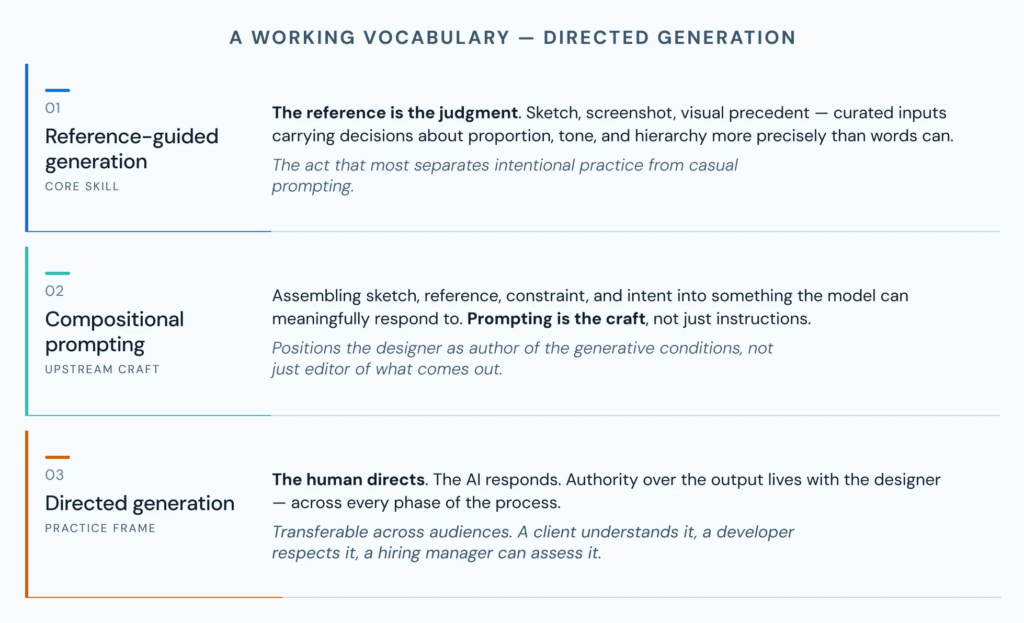
It starts with a reference. Not a prompt in the chatbot sense — a curated input. A sketch, a screenshot, a visual precedent, or sometimes a combination. The reference is the judgment. It carries decisions about proportion, tone, hierarchy, and intent that would take paragraphs to articulate in words and still not be as precise. Designers have always thought this way. We’ve just never had a tool that could receive visual intent directly and respond to it at the fidelity of code.
From there, the process moves through phases, and knowing when to shift between them is the actual skill.
- Sometimes you’re directing: composing the input, selecting references, and setting constraints before a single token is generated.
- Sometimes you’re collaborating: running iterations, reading output critically, adjusting the way you’d redirect a developer who’s technically capable but needs your eye.
- And sometimes you’re editing: inside the HTML or the Figma file, making calls no prompt can fully anticipate — like the spacing that feels of… the hierarchy that works technically but just doesn’t land…the detail the model optimized for consistency when the moment called for contrast.
- None of these phases is passive. The model responds to what you bring. It doesn’t supply taste; it pressure-tests yours.
- This is what gets flattened when someone calls it vibe coding. Not the description of the work, but the authorship of it.
The outcome: design that scales without freezing
There’s an implication to working this way — that most conversations about AI-assisted design haven’t really caught up to speed.
When judgment operates at the level of the pattern rather than the pixel, something shifts in how design systems can be conceived.
The traditional model treats patterns as fixed artifacts — defined, documented, and applied. Consistency comes from replication.
Flexibility is the first casualty.
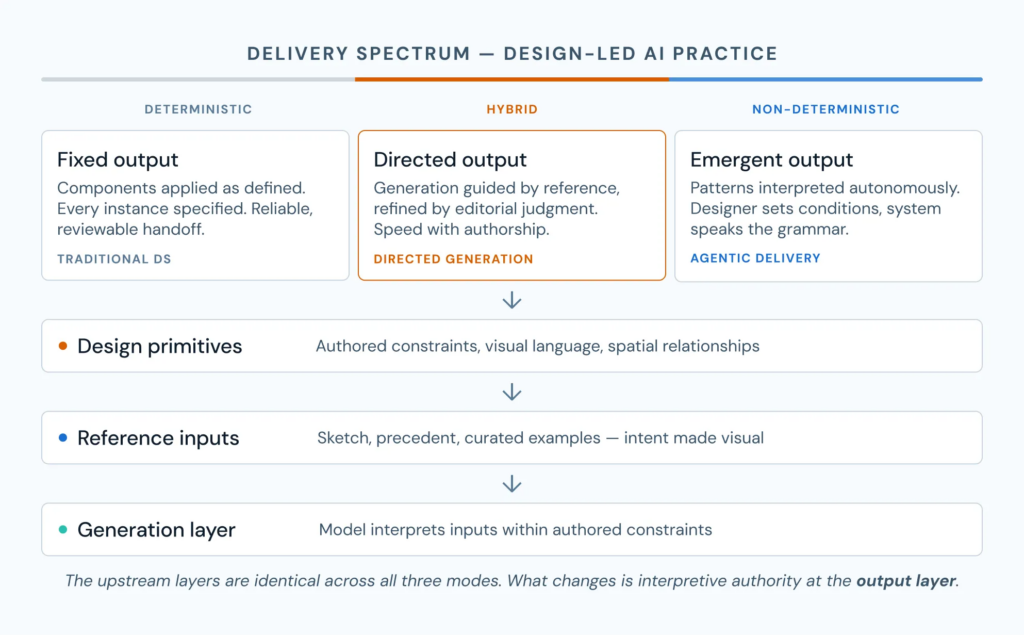
Directed generation changes that constrain. When a machine understands a design pattern abstractly enough to recompose it contextually — not copy it, but interpret it — the pattern behaves less like a static component and more like a set of spatial, typographic, and behavioral relationships that can be molded across surfaces it’s never seen before, across all devices and contexts.
The designer’s role shifts from specifying every instance to defining the conditions under which good instances reliably emerge.
This is a non-deterministic design. The output isn’t fully predicted, and that’s not a failure of the system — it’s the point. The craft moves upstream, into the quality of the primitives, the precision of the references, and the rigor of the constraints.
The natural endpoint of this is agentic delivery — systems that don’t just respond to design direction but carry it forward autonomously, generating coherent outputs across scale and context without losing the authoring intent embedded in the original primitives. Systematic design generation, not systematic design documentation. The designer authors the grammar. The system speaks it fluently.
That’s where this practice is heading. Directed generation isn’t a workaround for the limitations of AI tools. It’s the foundation for what those tools become next.
What to call it instead
Naming an emerging practice is messy work. Like any part of a system, done too early, the label calcifies before the practice has fully formed. Done too late, someone else’s term is already in the room.
One could say we’re at the late-early stage with AI-assisted design — the tools have matured enough that real methodologies have developed. But the vocabulary is still largely borrowed from engineering, from product management, from the breathless coverage of generative AI that treats every output as the point rather than the means to one.
A few terms are worth considering — not as a taxonomy, per se, but more like handles for the work. So let me take a shot at it:
- Directed generation places the emphasis where it belongs: on the human as the directing force. It’s transferable across audiences — a client understands it, a developer respects it, and a hiring manager can assess it.
- Reference-guided generation names the specific act that separates intentional practice from casual prompting. Bringing a curated visual input to a model and steering output toward a design context that exists in your judgment, not in the training data — that’s a skill. It deserves its own term.
- Compositional prompting describes the upstream act of assembling the inputs — sketch, reference, constraint, and intent — into something the model can meaningfully respond to. It positions prompting as a craft, not a set of instructions.
None of these is a mandate, just a suggestion. The point isn’t to win a naming debate. It’s to have language precise enough to think with and to communicate the work segments to people who need to understand its value.
But I do think the designers who define this practice will speak with more authority than those who inherit someone else’s shorthand for it.
Own the practice, own the description
There’s a reasonable objection to everything in this article: does it really matter what we call it? The work gets done either way. Clients see the output, not the methodology. Designers are pragmatic people.
It matters in crucial moments that are easy to underestimate. The portfolio review, where someone asks how you work. The client kickoff is where you’re establishing why your process is worth the rate. The team conversation where a junior designer is trying to understand what craft looks like in this new environment…
In all of those moments, having language for what you do — precise, confident, and yours — is professional clarity.
Designers have navigated this before. When UX emerged as a distinct discipline, the practitioners who named their own work — who said, “This is interaction design, this is information architecture, this is what I do and why it matters” — shaped how the field was valued for a generation. The ones who let adjacent fields define them spent years recovering ground.
AI-assisted design is at a similar inflection. Not because the technology is new — it’s already normalized. But because the practice is still being defined, the definitions that stick will come from somewhere. They’ll come from engineers describing what they shipped, or from journalists covering what’s legible, or from designers articulating what they actually do.
The traditional methodology (deterministic design) produces the most accurate account for clients, for teams, and for the designers coming up who need a model of what intentional design practice looks like when the tools are this powerful.
None of these demands a wholesale commitment to one mode of delivery. In production environments, deterministic outputs — fixed components, documented patterns, and predictable handoff — remain the right tool for many contexts.
The value of directed generation and non-deterministic design isn’t that they replace the design system; it’s that they expand what the design system can do. Generative wireframing, rapid concept exploration, and cross-surface pattern interpretation are where non-deterministic approaches deliver outsized returns.
Production-ready components may still need to be specified, reviewed, and locked. The hybrid approach is simply an honest acknowledgment that different phases of design work carry different risk tolerances, and a mature practice knows which mode to reach for.
Vibe coding describes one way of working with AI. It’s not a criticism of that mode — for some contexts, low-accountability generation is exactly the right tool. But it was never a description of design leadership. The sooner that distinction is clear, the sooner the work gets the framing it deserves.
Call it directed generation. Call it reference-guided practice. Call it compositional prompting.
Or find your own term that fits the specifics of how you work.
The article originally appeared on Medium.
Featured image courtesy: Jim Gulsen.
The post Beyond Vibe Coding: A Designer’s Case for Directed Generation appeared first on UX Magazine.
This post first appeared on Read More