
Knowing you are not the strongest in the room can sharpen you or wear you down. The research is oddly split, and the difference comes down to a handful of things you can control.
Watch the podium closely at almost any Olympic Games and you will catch something that does not instantly add up. The silver medallist, second-best on the planet at their event that day, often looks faintly gutted. The bronze medallist, standing one step lower, tends to be beaming. By the result, silver did better. So why does bronze so often look like the happier person?
It is not just the cameras catching a bad moment. In 1995, Victoria Medvec, Scott Madey and Thomas Gilovich went through footage from the earlier Barcelona Summer Olympics and rated the faces of medallists, both at the moment they finished and later on the stand. Writing in the Journal of Personality and Social Psychology, they reported that bronze medallists looked reliably happier than the silver ones who had beaten them. The people who came closer to the top felt worse about it.
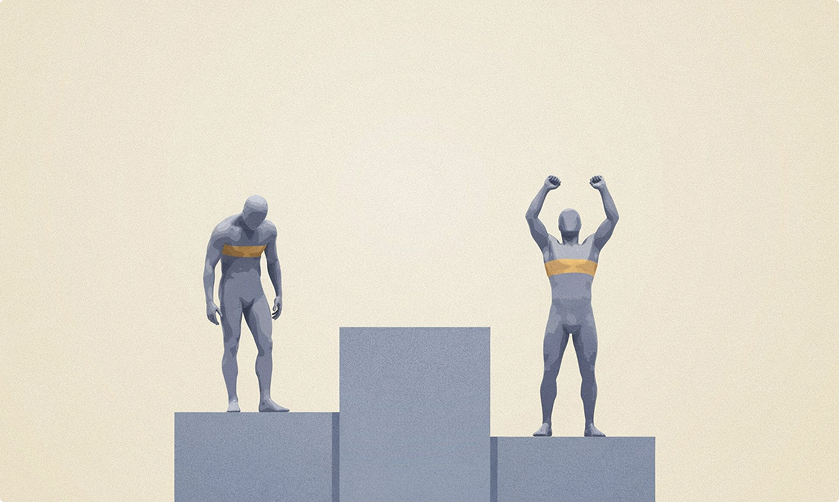
The reason is the comparison each athlete cannot help but reach for. Silver looks up at the gold that slipped away and thinks about how nearly it was theirs. Bronze looks down at fourth place, the near miss with nothing to show for it, and feels fortunate to be holding anything at all. Same podium, a very different film running in each head.
Counterfactual thinking is the label for it, the mind’s habit of playing the “what if” replay. And it has held up since: a more recent study ran facial-expression software over medal-stand photographs from several Olympic Games and found the same lopsided result.
Which sets up an awkward question for anyone who has ever been told to aim high. If getting close to the summit can leave you flatter than finishing further from it, should you really be aiming to be the best at all?
Two things wearing the same coat
The answer starts with a distinction we tend to skip. “Not being the best” is really two things bundled into one. One of them is the plain fact of it, a reasonably accurate read of where you stand. The other is the feeling that comes with it, the sting of measuring yourself against someone better. The first can be useful. The second is where things get slippery. For the silver medallist, the trouble was never what they knew, but the yardstick they chose.
The two can come apart. You can know perfectly well that you are middling at something and feel fine about it, the way most of us regard our own singing. You can also be objectively excellent and feel wretched. This is why so much of the usual advice misses its mark. “Be realistic” is aimed at the facts; “stop comparing yourself” at the sting. They are different problems, and they take different cures. The rest is learning to tell which one you are dealing with, and when to listen to it.
Reading yourself
Take the case in favour first. Knowing, accurately, that you are not the best is what lets you improve. After all, you cannot close a gap you cannot see.
This is the grain of truth buried inside the most over-quoted finding in popular psychology. In 1999, Justin Kruger and David Dunning reported that people who were worst at a task tended to wildly overrate themselves, while the truly skilled were more measured. The internet boiled this down to a meme: the incompetent are too clueless to spot it. What lies underneath is messier than that, and a good deal less settled. Several researchers now suspect much of the effect is a statistical illusion, a trick of the numbers rather than a real feature of the mind. One analysis even showed you can reproduce the famous chart from random data, which is hard to square with it saying anything about real people.
Even so, a smaller point stands. As you get better at something, you also get better at judging how good you are. Reading your own weaknesses is a skill in its own right, and it happens to be the one that makes progress possible. A designer who can see precisely where their work falls short has something to fix. One who thinks it is all flawless has nowhere left to go.
Faking it, making it
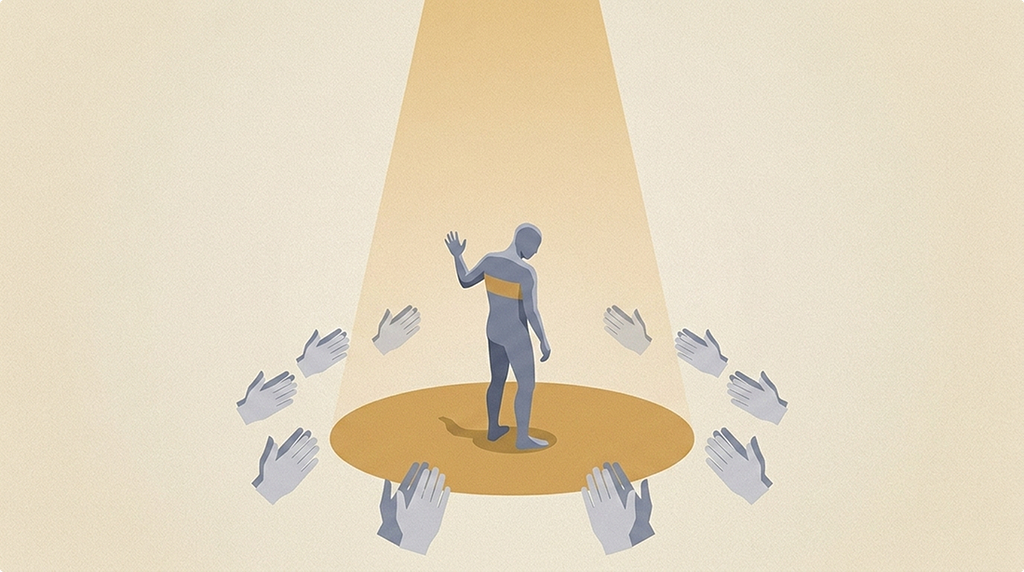
Feeling like a fraud seems a pure liability. Its story begins in a university counselling room in 1978, where the psychologists Pauline Rose Clance and Suzanne Imes kept meeting the same thing in high-achieving women: accomplished people privately certain they had fooled everyone, and that exposure was only a matter of time. One woman, told by her chairman that her paper was among the best he had ever read, assumed she had simply got away with something. The researchers called it the impostor phenomenon. It has since walked out of the clinic and taken up residence just about everywhere, from boardrooms to group chats.
For a long time the assumption was that these thoughts do nothing but damage. Then Basima Tewfik, a professor at MIT Sloan, looked more closely. In a 2022 paper in the Academy of Management Journal, she pried apart the thought itself (the belief that others rate you more highly than you rate yourself) from the distress usually assumed to come stapled to it. Across four studies involving more than 3,600 people, including surveys at an investment advisory firm and work with physicians in training, she found that those who had these impostor thoughts more often were rated by others as more interpersonally effective, with no dip in actual competence.
Her explanation is a kind of instinctive compensation. If you suspect you are not quite as good as people assume, you tend to turn outward, listen harder and read the room more carefully, and that attentiveness comes across as skill. In any work that leans on critique and collaboration, the person who feels like the weakest voice on the team may be the most valuable one on it.
Tewfik was careful not to overstate this, and neither should we. Those thoughts still chip away at self-esteem, and she was clear that they are not something to cultivate on purpose. But the neat story that believing yourself a fraud is simply and only bad for you does not survive her data.
Prove them wrong, but choose your doubter
Being underestimated carries its own strange charge. Samir Nurmohamed, of the Wharton School, studies what he calls underdog expectations, the sense that other people expect you to fail. Intuition says being written off is demoralising, and often it is. Yet he found that low expectations from others could sharpen performance rather than blunt it, powered by a very human engine, the urge to prove them wrong.
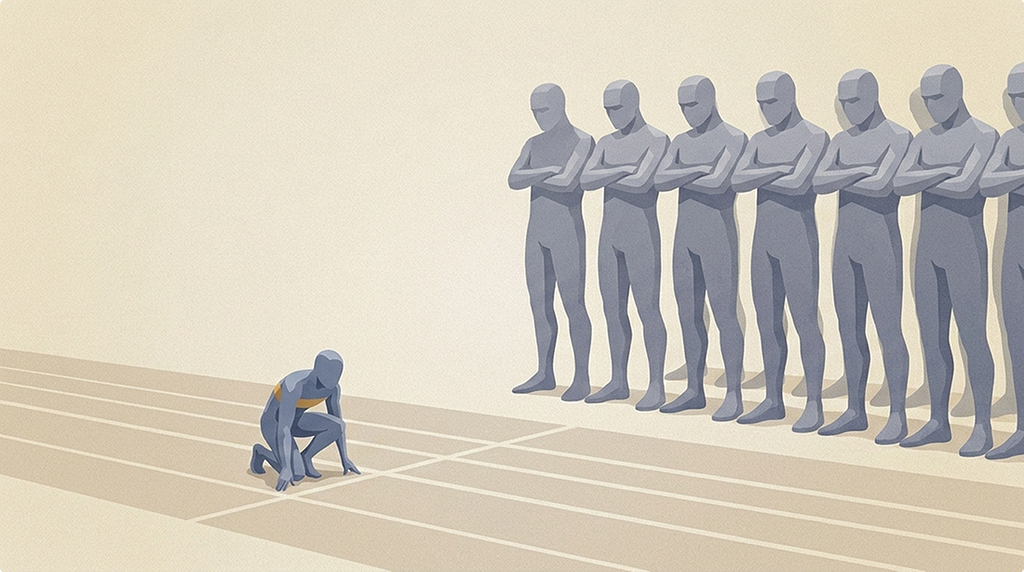
The crucial part comes with a condition: the effect flips depending on who is doing the doubting. When the doubter carries little credibility, being underestimated lights a fire. When it is someone whose judgement you respect, their low expectations tend to seep in and become self-fulfilling, dragging performance down with them. That darker version has a name of its own, the Golem effect, where being expected to fail helps make the failure happen. The doubt is identical; only the outcome flips, and that hinges on whether you buy the source.
The way you narrate your own position matters too. In 2021, Nurmohamed worked with 330 unemployed job seekers recruited from two re-employment centres in Pennsylvania, many of whom had faced discrimination. Those coached to cast themselves as underdogs, recalling times they had defied low expectations, came away more confident about landing work, and went on to fare better, than those who told “favourite” stories in which success had always been expected of them. The account you give of not being the obvious pick can, it seems, become fuel.
Small fish, big pond
Now the opposite case, where knowing starts to hurt. Put an able person in a room full of stronger people and, on average, something in them deflates.
Educational psychologist Herbert Marsh has spent much of his career on this, under a memorable name, the big-fish-little-pond effect. The evidence is consistent and a touch bleak.
Take two students of identical ability. Place one in a high-flying selective school and the other in an ordinary one, and the student surrounded by standout peers will tend to rate their own ability lower. He confirmed it across 26 countries using international student data, drawing on more than 100,000 fifteen-year-olds. Then a 2018 meta-analysis, gathering up decades of studies, showed the pattern held broadly across ages and settings.
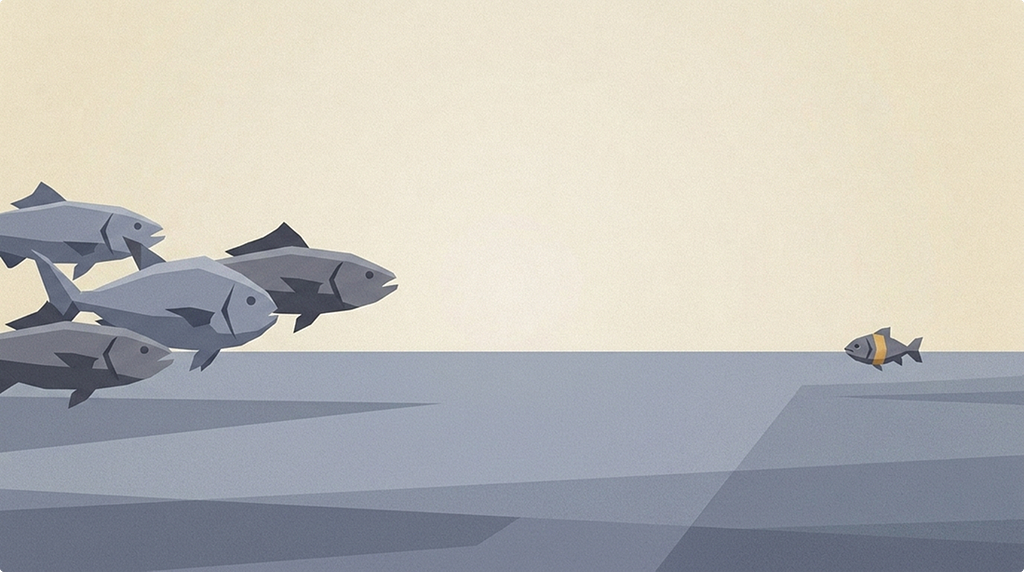
That lowered opinion of yourself does not stay put. How good you believe you are feeds directly into how well you go on to do, and how high you dare to aim next. This is the gifted-programme paradox: the very move meant to stretch a talented child, dropping them among equally talented peers, can shrink their belief in themselves. The pond grew, and everyone in it felt smaller. It is the silver medallist’s problem again, only stretched across years rather than one afternoon on a podium.
What tips the balance
Line these findings up and a shape appears. Knowing you are not the best is neither medicine nor poison by itself. A few things decide which it becomes.
The direction you look does the most. The silver and bronze stood inches apart and felt a gulf between them, because one looked up at what was missed and the other looked down at what was escaped. Looking up is not automatically corrosive, though. See someone ahead of you and think “I could get there,” and it pulls you forward. Let the same sight tip into “I never will,” and it drags you under. One person to admire, two ways to take it.
The rest is a matter of framing, of who is doing the judging, and of where you happen to be. Treated as a final verdict, “I am not the best” is a wall; treated as a starting line, it is a heading. Doubt from someone you respect sticks, while doubt from someone you dismiss slides off, which was Nurmohamed’s point. Beyond that, your surroundings can matter as much as any of it, which is where this stops being purely personal and becomes something other people build.
If you build the pond
Everything so far has been about the individual. But Marsh’s finding is really about the setting, not whoever is dropped into it. The same person thrives or wilts depending on where they land.
Think about an ordinary design career. Portfolio galleries, endless feeds of other people’s most polished work, the nagging suspicion that everyone else is shipping something lovelier than you are. That is upward comparison of precisely the punishing sort, all distance and no path to close it. A junior designer scrolling that stream is a small fish being shown an ocean of big ones, all day, with no visible route from here to there.
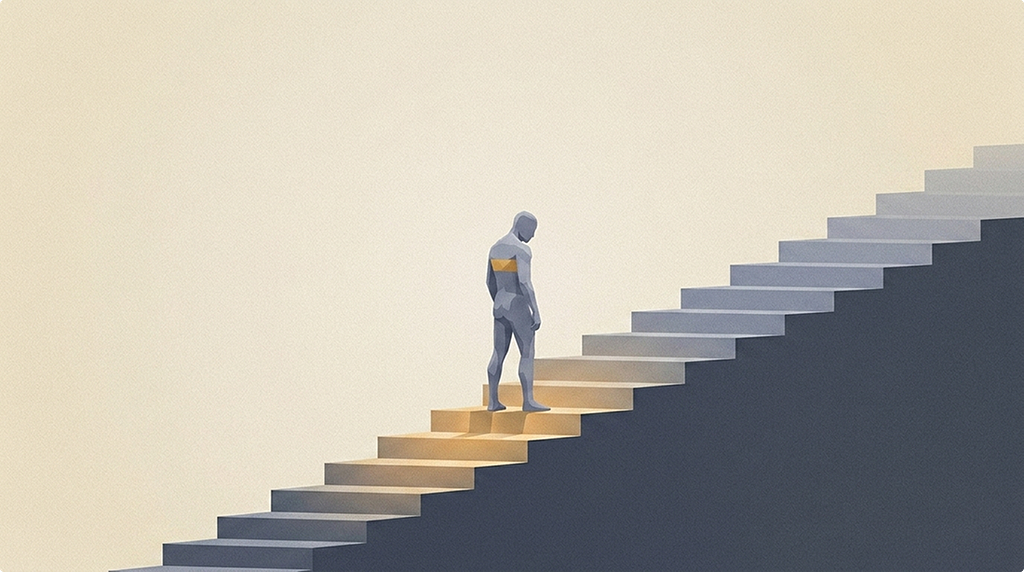
Teams carry the same hazard. Stack a group entirely with stars and the research suggests some of them will privately mark themselves down, even while their output stays strong. The answer is not to lower the bar, but to make the climb the point, not the ranking, so that “I am not the best here yet” reads as a spot on a journey instead of a ruling on your worth.
So far, so internal. But most of what designers make ends up in front of strangers, and a fair amount of it deliberately manufactures the feeling of not being the best in them. Leaderboards. Streaks. Follower counts. “You are in the 62nd percentile.” Social proof that parades everyone ahead of the user. They are, quite literally, choosing the comparison direction on people’s behalf, and the evidence says that choice is rarely neutral.
Strava is the clearest case. Its crowns, King and Queen of the Mountain, go to whoever has posted the fastest time a segment has ever seen, so almost everyone who rides that hill is a permanent runner-up, chasing a record they will never beat. In 2020 the company added Local Legends, a crown that ignores speed altogether. It goes to whoever rides a segment most often over a rolling 90 days. Ability drops out of the picture, dedication is the only currency, and it changes hands constantly. What shifted is what riders are judged on, and that was a design choice.
Duolingo keeps the competition but shrinks it. Its weekly leagues sort you into a pool of only about thirty learners, matched to your own pace, so someone doing a few lessons a week is not thrown in with the ones grinding a hundred. Almost anyone can finish near the front just by turning up, and that is no accident.
The gentler move is to drop the crowd altogether. Apple’s activity rings close against a goal you set yourself, so nobody is ahead of you at all, because the only benchmark is your past self. It all points backward, at progress made, rather than forward at the gap to the top.
Peloton lets the rider choose outright. Its leaderboard can show the whole class, or only your age group, or only people you follow, or, with a “Just Me” filter, nobody at all, so you race your own earlier rides. One control, and today becomes a contest with the whole field or with last week’s self, whichever the rider prefers.
Point someone towards an unreachable top with no way to climb, and you hand them the silver medallist’s flatness. Offer a downward glance at how far they have come, or a rung within reach, and you hand them the bronze medallist’s lift. Same data, different film, and the business decides which one plays.
Kinder by design
Clear feedback still helps. Seeing where you come up short is how anyone improves, whether you are the user or the maker. The skill is in what you weigh it against, and a few guidelines can start paving the way:
- Default to the user’s own past. It works for almost everyone; a public ranking works only for the few at the top.
- If you must rank, make first place reachable and mark the step just above where someone stands. A ladder people can climb beats a peak only the elite will ever hold.
- Reward progress, not just position. Someone shown the ground they have already covered gets the bronze medallist’s view, the one that lifts.
- Let people pick their crowd. A filter that shrinks the field, or clears it, returns that choice to the person it affects.

So, should you?
Back to the question in the title. Should you aim to be the best?
Aiming high is fine. The trap is measuring yourself against the summit alone, so that anything short of it registers as failure. The silver medallist and the small fish are never let down by the facts. What does the damage is the yardstick, and it can be changed, chosen, and, for those who design things, handed to other people with a bit of care.
Knowing you are not the best can be the most useful thing you know about yourself. It shows you where to go. It turns you outward. It can even be the spark that makes you prove a doubter wrong. Or it can be the slow weight that talks a capable person out of reaching at all. The knowledge is identical in every case; whether it lifts you or flattens you turns entirely on what you set beside it.
If you enjoyed this, follow me on Medium for more on design, psychology and technology.
References
Clance, P. R., & Imes, S. A. (1978). The impostor phenomenon in high achieving women: Dynamics and therapeutic intervention. Psychotherapy: Theory, Research & Practice, 15(3), 241–247. https://paulineroseclance.com/pdf/ip_high_achieving_women.pdf
Fang, J., Huang, X., Zhang, M., Huang, F., Li, Z., & Yuan, Q. (2018). The big-fish-little-pond effect on academic self-concept: A meta-analysis. Frontiers in Psychology, 9, 1569. https://www.frontiersin.org/journals/psychology/articles/10.3389/fpsyg.2018.01569/full
Fix, B. (2022). The Dunning-Kruger effect is autocorrelation. Economics from the Top Down. https://economicsfromthetopdown.com/2022/04/08/the-dunning-kruger-effect-is-autocorrelation/
Gignac, G. E., & Zajenkowski, M. (2020). The Dunning-Kruger effect is (mostly) a statistical artefact: Valid approaches to testing the hypothesis with individual differences data. Intelligence, 80, 101449. https://doi.org/10.1016/j.intell.2020.101449
Hedgcock, W. M., Luangrath, A. W., & Webster, R. (2021). Counterfactual thinking and facial expressions among Olympic medalists: A conceptual replication of Medvec, Madey, and Gilovich’s (1995) findings. Journal of Experimental Psychology: General. https://pubmed.ncbi.nlm.nih.gov/33166162/
Kruger, J., & Dunning, D. (1999). Unskilled and unaware of it: How difficulties in recognizing one’s own incompetence lead to inflated self-assessments. Journal of Personality and Social Psychology, 77(6), 1121–1134. https://doi.org/10.1037/0022-3514.77.6.1121
Marsh, H. W., & Hau, K.-T. (2003). Big-fish-little-pond effect on academic self-concept: A cross-cultural (26-country) test of the negative effects of academically selective schools. American Psychologist, 58(5), 364–376. https://pubmed.ncbi.nlm.nih.gov/12971085/
Medvec, V. H., Madey, S. F., & Gilovich, T. (1995). When less is more: Counterfactual thinking and satisfaction among Olympic medalists. Journal of Personality and Social Psychology, 69(4), 603–610. https://doi.org/10.1037/0022-3514.69.4.603
Nurmohamed, S. (2020). The underdog effect: When low expectations increase performance. Academy of Management Journal, 63(4), 1106–1133. https://doi.org/10.5465/amj.2017.0181
Nurmohamed, S., Kundro, T. G., & Myers, C. G. (2021). Against the odds: Developing underdog versus favorite narratives to offset prior experiences of discrimination. Organizational Behavior and Human Decision Processes, 167, 206–221. https://www.sciencedirect.com/science/article/pii/S0749597821000479
Tewfik, B. A. (2022). The impostor phenomenon revisited: Examining the relationship between workplace impostor thoughts and interpersonal effectiveness at work. Academy of Management Journal, 65(3), 988–1018. https://journals.aom.org/doi/abs/10.5465/amj.2020.1627

Should you really aim to be the best? was originally published in UX Collective on Medium, where people are continuing the conversation by highlighting and responding to this story.
This post first appeared on Read More