
Udemy or Coursera? Which one is better for Developers
Hello friends, while many of you know already that Udemy and Coursera are merging together, one of the questions I get most often from developers is: Udemy or Coursera? Which one is actually worth your money in 2026?
It’s a fair question, and not a simple one. I’ve spent years taking courses on both platforms — from web development bootcamps on Udemy to professional certificates from Google and IBM on Coursera.
I’ve used both to learn Java, Python, AI, system design, cloud computing, and more.
Here’s my honest take: they’re both excellent — but for very different reasons, and for very different types of learners. Understanding that distinction will save you time, money, and a lot of frustration.
Let’s break it down properly.
The Core Difference: What Each Platform Actually Is?
Before comparing features, it helps to understand the fundamental model difference, because it shapes everything else.
Udemy is a course marketplace. Anyone can create and sell a course. You buy individual courses and get lifetime access — once purchased, you can rewatch lectures, download resources, and revisit the content anytime, forever.
There are no deadlines, no cohorts, no subscriptions required.
Udemy: Online Courses for Skills, Careers & AI
Coursera is a university and enterprise partnership platform. It works with top institutions — Google, Stanford, Meta, IBM, MIT — to offer professional certificates, guided specializations, and even full degrees.
It runs primarily on a subscription model through Coursera Plus (~$399/year for unlimited access to 7,000+ courses) or individual certificate purchases.
The simplest version:
- Udemy = pay once, learn forever, on your terms
- Coursera = subscribe monthly, earn university and company-backed credentials
1. Course Quality and Instructor Expertise
Both platforms have exceptional content — but in different categories.
Udemy’s strength is practical, hands-on, instructor-led courses built by working developers, bootcamp instructors, and industry professionals. The courses that dominate here are exactly what developers need to actually build things:
- 100 Days of Code: The Complete Python Pro Bootcamp by Angela Yu
- The Web Developer Bootcamp by Colt Steele
- Java Programming Masterclass by Tim Buchalka
- The AI Engineer Course 2026: Complete AI Engineer Bootcamp
These are project-based, constantly updated, and focused on what you can build by the end. The caveat: since anyone can publish on Udemy, quality varies. The solution is simple — stick to courses with 50,000+ students and 4.5+ ratings from instructors with strong track records.
Coursera’s strength is academic rigor and brand credibility. Every course is developed with a university or major tech company, which means a consistent quality floor that Udemy’s open marketplace can’t guarantee. The flagship programs here include:
- Google IT Automation with Python Professional Certificate
- Meta Front-End Developer Certificate
- Deep Learning Specialization by Andrew Ng (Stanford/DeepLearning.AI)
- IBM AI Developer Professional Certificate
If you’re looking for a structured, academically-designed learning experience with content that’s been vetted and co-produced by the companies that actually hire for these roles, Coursera is where to look.
2. Learning Experience and Structure
This is where the two platforms feel most different day to day.
Udemy is flexible and self-directed. Each course is standalone — you start wherever you want, skip sections you know, and complete it at whatever pace fits your schedule.
There are no deadlines, no cohorts, no graded assignments from other students.
This is ideal for developers who are learning a specific technology on the side of a full-time job or who already know what they need and just want the content.
Coursera is structured and progressive. Courses are organized into specializations and professional certificates that build on each other over 3–6 months.
You’ll complete structured assessments, peer-graded projects, and in many programs, capstone projects that produce real portfolio work.
Many certificates also include career support: resume reviews, interview prep, and in some cases, direct connections to employers through job placement programs.
The bottom line:
3. Pricing — Where They’re Very Different
This is the key point:
Udemy Pricing
Udemy runs frequent sales where $200 courses go for $10–15. You buy once and keep the course forever — no recurring charges, no subscription required. For developers who want to pick up a specific technology, this is hard to beat.
The Udemy Personal Plan (~$30/month) is also available if you plan to take multiple courses and want unlimited access to 11,000+ courses — significantly better value than buying individually if you’re an active learner.
Here is the link to → Join Udemy
Coursera Pricing
Coursera works best through Coursera Plus — $399/year or $59/month for unlimited access to 10,000+ courses, specializations, and professional certificates from Google, Meta, IBM, Stanford, and more. Financial aid is available for those who qualify.
Individual professional certificates are also available — typically $39–49/month per program.
Here is the link to → Join Coursera Plus
The pricing verdict:
- For a single skill: Udemy wins on price, every time
- For multiple certificates over a year: Coursera Plus is the better deal
4. Certifications and Career Value
This is the most important differentiator for developers who want their learning to show up on a resume.
Udemy certificates are completion certificates. They carry no accreditation and most employers don’t treat them as credentials in themselves. Their value lies in the skills you demonstrate, not the certificate — which means your portfolio, GitHub, and what you can build matter far more than the Udemy certificate you earned.
Coursera certificates are co-branded with Google, IBM, Meta, Stanford, and other globally recognized institutions.
A Google Data Analytics Certificate or an IBM AI Engineering Certificate carries genuine resume weight. Some Coursera programs are ACE® recommended, qualifying for college credit at participating US institutions, and several pathway programs connect directly into university degrees.
If credential recognition matters for your career goals — job hunting, career transitions, or academic pathways — Coursera is the clear winner on this dimension.
Coursera | Courses, Professional Certificates, and Degrees Online
5. Free Content and Trials
Both platforms offer meaningful free access:
Udemy has a large library of free programming courses, particularly for beginner topics like Python, JavaScript, SQL, and C++. Many top instructors also release limited free versions or coupons.
Coursera offers free audit access to most courses — you get the full course content without paying, only paying if you want the certificate at the end. Coursera Plus also offers a 7-day free trial, which is worth using to explore multiple programs before committing.
6. Which Should You Choose in 2026?
Here’s my honest recommendation based on your situation:
Choose Udemy if you:
- Want to learn a specific technology quickly and practically
- Prefer self-paced learning without deadlines or structured paths
- Are on a tight budget and want the best value per course
- Already have a job and are building skills on the side
- Learn best by building projects rather than structured assessments
Choose Coursera if you:
- Need a recognized credential that carries weight in job applications
- Are making a career transition into tech, AI, or data science
- Prefer structured learning with guided progression and assessments
- Want to take multiple certifications across a year (Coursera Plus is better value)
- Are targeting credentials from Google, IBM, Meta, or top universities
To kickstart your AI and Machine Learning learning on Coursera, these are the programs I’d recommend starting with:
- Microsoft AI & ML Engineering Professional Certificate
- Google AI Essentials
- Deep Learning Specialization by Andrew Ng
7. My Personal Strategy — Use Both
After years of using both platforms, here’s the approach I’ve settled on — and what I recommend to most developers:
Use Udemy to build skills fast. When I need to learn a new framework, pick up a tool, or go deep on a specific technology quickly, Udemy is where I go. The practical, project-based courses get me building things faster than any other format.
Use Coursera for credentials and structured learning. When I want something that carries professional weight — a certificate from Google, IBM, or a top university — or when I’m building knowledge in a domain that benefits from structured progression (like machine learning or cloud architecture), Coursera is the better investment.
Together, they’ve completely replaced traditional education for me as a developer. The combination of Udemy’s affordability and practical depth with Coursera’s credibility and structure covers every learning need I have.
Final Comparison: Udemy vs Coursera in 2026
Here is a clear comparison of Udemy and Coursera for your reference:
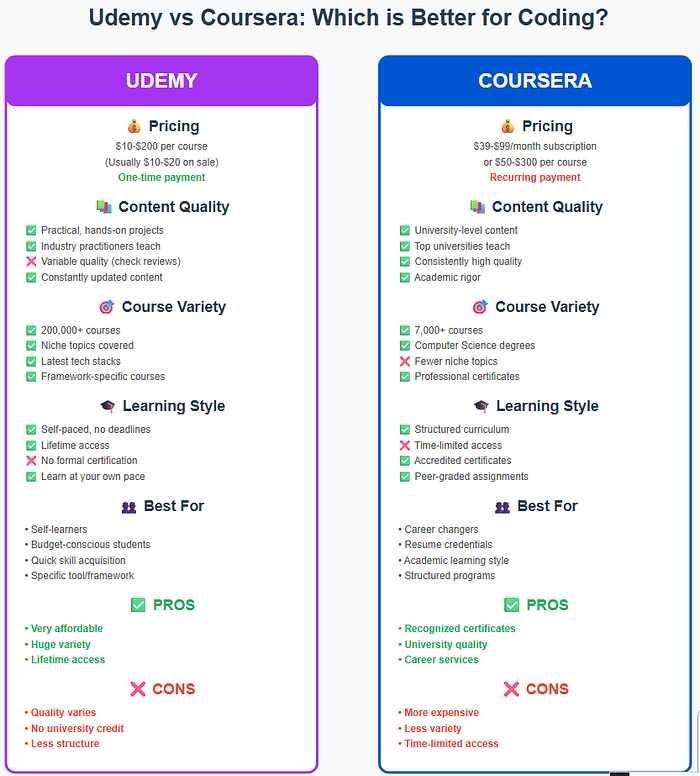
The Verdict
If you’re just starting to learn programming, Udemy is the best place to begin. Buy a top-rated Python or web development course for the price of a coffee, get lifetime access, and start building things immediately.
If you’re aiming for a career transition, targeting a role at a major tech company, or want credentials that carry genuine weight on your resume, Coursera is worth every penny.
Certificates from Google, IBM, Stanford, and Meta open doors in ways that Udemy completion certificates don’t.
And if you can afford to use both — do it. That combination has been the most effective approach to continuous learning I’ve found in years of testing every major platform.
Happy learning!
P.S. — If you’re going to try only one platform first, use this rule: if you need a specific skill fast and affordably, start with Udemy. If you need a credential that opens career doors, start with Coursera Plus. You can always add the other one later — and most serious learners eventually use both.
Udemy: Online Courses for Skills, Careers & AI

I Tried Both Udemy and Coursera: Here Is My Recommendation for Developers in 2026 was originally published in Javarevisited on Medium, where people are continuing the conversation by highlighting and responding to this story.
This post first appeared on Read More