
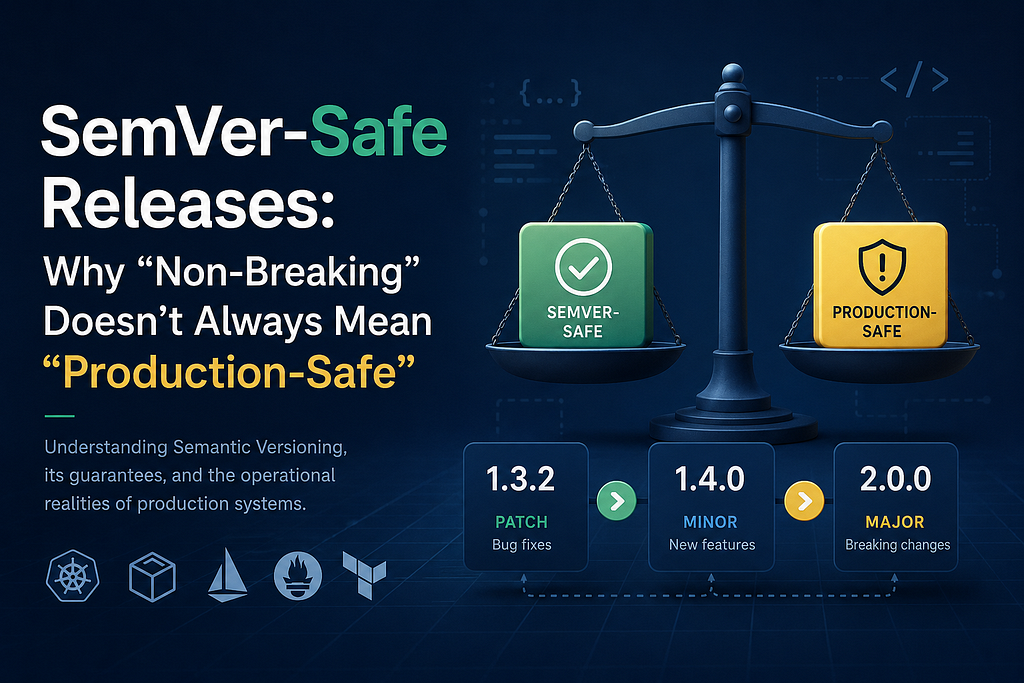
SemVer-Safe Releases: Why “Non-Breaking” Doesn’t Always Mean “Production-Safe”
Modern software delivery depends on one deceptively simple promise:
“You should be able to upgrade safely without breaking things.”
That promise is the foundation of Semantic Versioning (SemVer) — the versioning convention used across modern software ecosystems from cloud-native infrastructure to frontend frameworks.
But if you’ve operated production systems long enough, you know the uncomfortable truth:
A release can be semver-safe and still wake up your on-call engineer at 2 AM.
Let’s unpack what “semver-safe releases” actually mean, where the model works well, and where reality gets messier in distributed systems.
Understanding Semantic Versioning
Semantic Versioning uses a three-part version number:
MAJOR.MINOR.PATCH
Example:
2.4.7
- 2 → MAJOR version
- 4 → MINOR version
- 7 → PATCH version
The intent is straightforward:
-------------------------------------------------------------------
Version       Change                     Meaning Compatibility
-------------------------------------------------------------------
PATCH         Bug fixes                  Backward compatible
MINOR         New features               Backward compatible
MAJOR         Breaking changes allowed   Not guaranteed compatible
-------------------------------------------------------------------
What Makes a Release “SemVer-Safe”?
In most engineering teams, “semver-safe” means:
“You can upgrade without expecting breaking API changes.”
That generally includes:
- Patch upgrades
- Minor upgrades within the same major version
Examples:
Safe-ish upgrades:
1.3.2 → 1.3.9
1.3.2 → 1.4.0
Potentially breaking:
1.3.2 → 2.0.0
This convention enables automation at scale.
Why SemVer Became Essential
Without SemVer, dependency management would become chaos.
Modern systems rely on thousands of transitive dependencies:
- Kubernetes operators
- SDKs
- Service meshes
- Terraform providers
- Helm charts
- Frontend packages
- Observability agents
SemVer enables tools to automate updates safely.
Examples:
- Renovate automatically merging patch releases
- Dependabot opening safe upgrade PRs
- CI/CD pipelines allowing minor-version upgrades
- Package managers resolving dependency trees intelligently
Entire cloud-native ecosystems depend on these assumptions.
Projects like:
- Kubernetes
- Envoy Proxy
- Helm
- Prometheus
all heavily rely on SemVer conventions.
The Problem: “Compatible” Is Not the Same as “Safe”
This is where experienced SREs and platform engineers become skeptical.
A release may technically preserve API compatibility while still introducing operational risk.
Examples:
- Default timeout values change
- Retry behavior changes
- CPU usage increases
- Memory allocation patterns shift
- Connection pooling logic changes
- Log verbosity explodes
- Background jobs behave differently
- Feature flags become enabled by default
None of these may violate SemVer rules.
Yet all of them can impact production systems dramatically.
The Distributed Systems Reality
Distributed systems expose the limits of SemVer quickly.
In simple libraries:
- backward compatibility is easier to define
In distributed systems:
- behavior is part of the contract
A small internal change can cascade through:
- latency
- retries
- thread pools
- TCP behavior
- backpressure
- autoscaling
- observability pipelines
Consider a service mesh upgrade:
- APIs remain identical
- configuration schemas remain valid
- deployment succeeds cleanly
But:
- sidecar memory usage increases 20%
- p99 latency shifts upward
- mTLS handshake behavior changes
- circuit breaker defaults become more aggressive
Technically semver-safe.
Operationally risky.
The Kubernetes Ecosystem Is Full of These Examples
Teams often discover this firsthand when upgrading:
- Istio
- Terraform
- Kubernetes CRDs
- ingress controllers
- CSI drivers
- CNI plugins
- observability stacks
A “minor” version bump can still require:
- canary rollouts
- traffic shadowing
- node pool isolation
- staged regional deployments
- regression benchmarking
This is why mature platform teams rarely trust SemVer blindly.
SemVer Is a Contract — But Only About Certain Things
Semantic Versioning primarily protects:
- public APIs
- function signatures
- documented interfaces
It does not guarantee:
- performance stability
- latency consistency
- memory efficiency
- resource consumption
- scalability behavior
- operational characteristics
That distinction matters enormously in production infrastructure.
How Mature Engineering Teams Handle “Safe” Releases
Experienced teams treat upgrades differently based on risk class.
Typically Auto-Approved (Backed by Automated Test Results)
- Patch releases for mature libraries
- CVE fixes
- Logging-only improvements
- Documentation-only changes
Usually Tested in Staging (Backed by Manual and Automated Test suites)
- Minor releases
- Dependency tree shifts
- Runtime upgrades
- Networking stack changes
Carefully Controlled ( Backed by long term planning and Load Testing)
- Major version upgrades
- Database engine upgrades
- Service mesh upgrades
- Kubernetes control plane upgrades
The important mindset shift is:
“SemVer reduces risk. It does not eliminate risk.”
Dependency Syntax and “Safe Upgrade” Ranges
Many package managers encode SemVer assumptions directly.
Examples:
^1.4.2
Means:
- allow only patch updates
- accept 1.4.x
You’ll see this across:
- npm
- Go modules
- Cargo
- Python tooling
- Helm charts
These operators exist because ecosystems trust SemVer behavior.
The Most Important Operational Lesson
The longer you operate production systems, the more you realize:
Compatibility is multidimensional.
A release may preserve:
- APIs
- schemas
- interfaces
while still changing:
- runtime characteristics
- scaling patterns
- failure modes
- traffic behavior
This is especially true in:
- microservices
- Kubernetes platforms
- observability pipelines
- networking layers
- streaming systems
Final Thoughts
Semantic Versioning is one of the most important social contracts in software engineering.
Without it:
- dependency management would become nearly impossible
- automation would collapse
- cloud-native ecosystems would slow dramatically
But SemVer is ultimately:
- a convention
- a trust model
- a compatibility guideline
— not a guarantee of operational safety.
The best engineering organizations understand both sides:
- trust SemVer enough to move fast
- distrust it enough to test carefully
That balance is where resilient platform engineering lives
- 4 → MINOR version
- 7 → PATCH version
The intent is straightforward:
Version ChangeMeaningCompatibilityPATCHBug fixesBackward compatibleMINORNew featuresBackward compatibleMAJORBreaking changes allowedNot guaranteed compatible

SemVer-Safe Releases: Why “Non-Breaking” Doesn’t Always Mean “Production-Safe” was originally published in Javarevisited on Medium, where people are continuing the conversation by highlighting and responding to this story.
This post first appeared on Read More