
✨ Introduction
Google I/O 2026 wasn’t just another developer conference — it was a declaration that the future of cloud and AI is agentic. Instead of AI being a passive assistant, Google unveiled systems that can reason, act, and integrate autonomously into workflows. For SREs, DevOps engineers, and developers, this marks a turning point: AI is no longer just helping us write code or analyze logs; it’s becoming part of the infrastructure itself.
🚀 Gemini 3.5 Flash — Speed Meets Intelligence
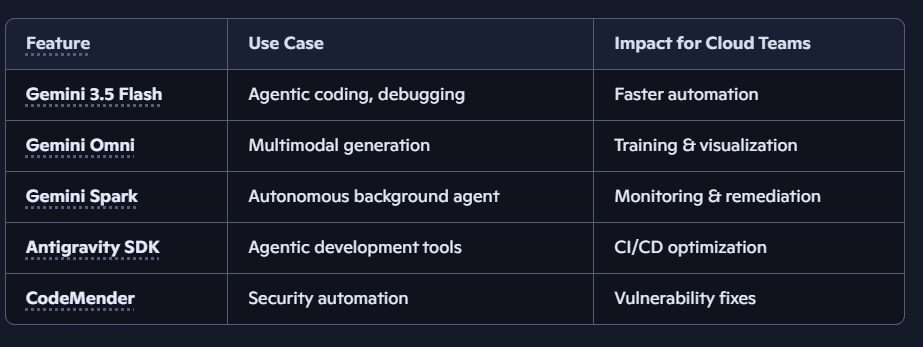
The headline announcement was Gemini 3.5 Flash, Google’s fastest model yet. It’s designed for agentic coding, multimodal reasoning, and long-horizon tasks. Benchmarks show it outperforming GPT‑5.5 and Claude Opus 4.7 in tool use, debugging, and complex analysis.
For SREs and DevOps, this means:
- Faster incident resolution with AI-driven debugging.
- Automated runbooks that adapt in real time.
- Anomaly detection at scale, without the latency or cost overhead of older models.
🎥 Gemini Omni — Multimodal AI for Real-World Context
Gemini Omni takes multimodality to the next level. It can generate and edit video, audio, text, and images, while also understanding physics and real-world dynamics.
For infrastructure teams, this unlocks:
- Incident visualization: Imagine replaying a system failure as a simulation, not just a log file.
- Training simulations: Realistic scenarios for onboarding new engineers.
- Knowledge-sharing: Rich, multimodal documentation that goes beyond text.
⚡ Gemini Spark — Always-On Autonomous Agents
With Gemini Spark, Google introduced autonomous agents that run continuously on Cloud VMs. These agents handle multi-step tasks in the background, asking for approval only when critical actions are needed.
For SREs, Spark could become the tireless teammate that:
- Monitors logs and metrics 24/7.
- Flags anomalies before they escalate.
- Suggests or even executes remediation workflows.
🛠️ Google Antigravity SDK — Building Agentic Workflows
The Google Antigravity SDK expands CLI and SDK capabilities for agentic development. It integrates with the Gemini Enterprise Agent Platform, enabling developers to build workflows where AI agents act as first-class citizens.
For DevOps, this means:
- Smarter CI/CD pipelines that optimize themselves.
- Infrastructure-as-code enhanced with AI-driven recommendations.
- Reduced toil in repetitive deployment tasks.
🔒 Cloud Security AI — Proactive Defense
Security wasn’t left behind. Google introduced Cloud Security AI, featuring CodeMender, an AI agent that scans and fixes vulnerabilities automatically. SynthID watermarking was also extended to Search and Chrome, helping verify authenticity in AI-generated content.
For DevSecOps teams, this translates to:
- Automated vulnerability detection and patching.
- Compliance verification without manual overhead.
- Stronger guardrails against misinformation and tampered data.
📊 Comparison Snapshot
⚠️ Risks & Challenges
Of course, every leap forward comes with challenges:
- Cost scaling: Google’s $180–190B capex in 2026 signals rising infrastructure costs. Teams must monitor usage carefully.
- Agent autonomy: Spark agents are powerful, but without guardrails, they risk over-automation.
- Data authenticity: SynthID helps, but human validation remains critical in high-stakes workflows.
📝 Conclusion
Google I/O 2026 marks the beginning of agentic AI in cloud workflows. For SREs, DevOps engineers, and developers, this isn’t just about faster tools — it’s about AI becoming part of the infrastructure team.
The future of cloud isn’t just AI-assisted. It’s AI-augmented infrastructure, where autonomous agents debug, secure, and optimize systems alongside us. The question isn’t whether we’ll adopt these tools — it’s how quickly we can integrate them into our workflows without losing control.

Google I/O 2026: The Agentic AI Era for Cloud Professionals was originally published in Javarevisited on Medium, where people are continuing the conversation by highlighting and responding to this story.
This post first appeared on Read More