
Welcome to This Week in Neo4j, your fix for news from the world of graph databases!
Neo4j is acquiring GraphAware – friends and fellow graph believers for many years – and their Hume platform now gives governments a genuine open-standards alternative to black-box tools like Palantir Gotham.
This edition also brings major product drops: Neo4j Virtual Graph enters private preview, enabling Cypher and graph algorithms to run directly against your Snowflake or Databricks data with zero ETL and Document Intelligence arrives in Aura, turning raw PDFs and docs into queryable hybrid knowledge graphs in minutes. We also take a look at five battle-tested techniques for keeping agents grounded – from GraphRAG-backed aggregation to runtime self-correction.
The Call for Papers for NODES 2026 is still open until June 15 – if you have a graph story to tell, now is the time to submit. Yolande also has written a handy guide with tips for your submission.
Share your experiences and influence the future of Neo4j products: Join the Neo4j User Research panel! It’s a chance to connect directly with product development teams, get paid compensation, hear about what we are working on and more!
Happy Graphing,
Alexander Erdl
COMING UP!
- Livestream: Neo4j GenAI Plugin: embed, search, generate on June 9
- Conferences: Find us at AgentCon, Rio de Janiero on June 13, Databricks Data+AI Summit, San Francisco on June 15-18, Gartner D+A, Syndey on June 16-17, AgentCon, Bengaluru on June 20
- Meetup: Meet us in Malmö, SE on June 9, Rio de Janeiro, BR on June 11, Mumbai, IN on June 17 & Bengaluru, IN on June 19
- All Neo4j Events: Webinars and More
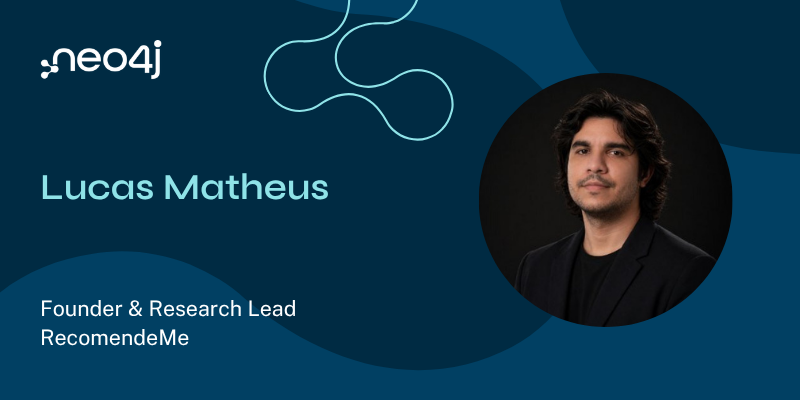
FEATURED COMMUNITY MEMBER: Lucas Matheus
Matheus is an independent AI & OSINT researcher, systems architect, and founder of RecomendeMe, a data-driven cultural recommendation platform.
Connect with him on LinkedIn.
He has one of the first confirmed sessions at NODES 2026 “Building an AI-Driven 4-Layer Intelligence Architecture with Neo4j for OSINT Investigations”, where he will present how he transformed fragmented open data and OSINT sources into actionable intelligence.
GRAPHAWARE: Welcome, GraphAware
I’m thrilled to welcome our friends at GraphAware to Neo4j. Thinking back to GraphConnect Europe 2016, where I first met Michal, the GraphAware team has been tireless advocates for graph technology ever since, and it’s been a privilege to work alongside so many of them over the years. GraphAware Hume, their flagship intelligence analysis platform, now positions as an open-standards alternative to proprietary tools like Palantir Gotham. As Emil put it: “For over a decade, governments have utilized proprietary, black-box intelligence analysis software. Now they have a legitimate open-standard alternative.”
ARCHITECTURE: Introducing Neo4j Virtual Graph: Graph reasoning on the data you already have
Firat Tekiner and Michael Simons introduce Neo4j Virtual Graph, now in private preview: run Cypher queries and graph algorithms directly against your Snowflake or Databricks tables with zero data movement – your Cypher gets compiled deterministically into SQL and executed in place, inside your existing governance perimeter. The post also gives a clear-headed breakdown of when to use Virtual Graph versus a natively stored Neo4j graph, which is worth reading on its own. If you have warehouse data you’ve been wanting to apply graph reasoning to without standing up an ETL pipeline, this is the preview to join.
KNOWLEDGE GRAPH: Introducing Document Intelligence: From documents to a knowledge graph, right inside Aura
Firat Tekiner, Estelle Scifo and Michael Hunger introduce Document Intelligence, now in preview across all Aura tiers: drop in PDFs, DOCXs, or Markdown files, describe what you want extracted in plain English, preview the resulting graph and import it directly into your Aura instance – no extraction pipeline, no schema scaffolding. The output is a hybrid graph with a lexical layer for passage retrieval and an entity layer for structured traversal, wired together and queryable immediately via Cypher, Aura Agents, or the built-in chat interface. Worth spinning up on a real document set – it’s live now.
AI AGENTS: Stop AI Hallucinations With These 5 Techniques
In this video, Elizabeth Fuentes Leone walks through five concrete techniques to stop silent agent failures: semantic tool selection that reduces token usage from thousands to under 300, GraphRAG for verifiable aggregation and multi-hop answers, multi-agent validation, Python-enforced symbolic guardrails, and runtime steering that self-corrects without blocking the user. Each technique comes with a before/after demo using the open-source Strands Agents framework, with all code in the linked repo.
HACKATHON: Aura Agents
The Aura Agent Hackathon is in full swing and projects can be submitted through June 15. The community is already building some seriously impressive projects.
Complete the Building Agents in Neo4j Aura course by June 15, register for your $100 Aura credits and build an AI agent powered by a knowledge graph. Prizes including Bose QuietComfort Ultra Headphones, a Raspberry Pi 5, Aura credits and a newly designed Neo4j “Agent” T-shirt.

CONTINUOUS LEARNING
- GraphAcademy: There is still time to complete the “Building Agents in Neo4j Aura” course and get free Aura Credits
- Learn on Your Schedule: Go deeper into graph technology on Neo4j’s On-Demand webinar library
- Workshops: Join our virtual classrooms workshops from Fundamentals to GenAI
- New Webinar: Move AI From Pilot to Production: A Fireside Chat With Arhasi – Americas, Europe, Middle East & Africa, Asia Pacific
POST OF THE WEEK: Blue Guardrailsfrom the Neo4j Startup Program.
Please share it if you like it!
This article first appeared on Read More