
Some of the world’s biggest technology companies are quietly elevating design from a support function to a strategic one.
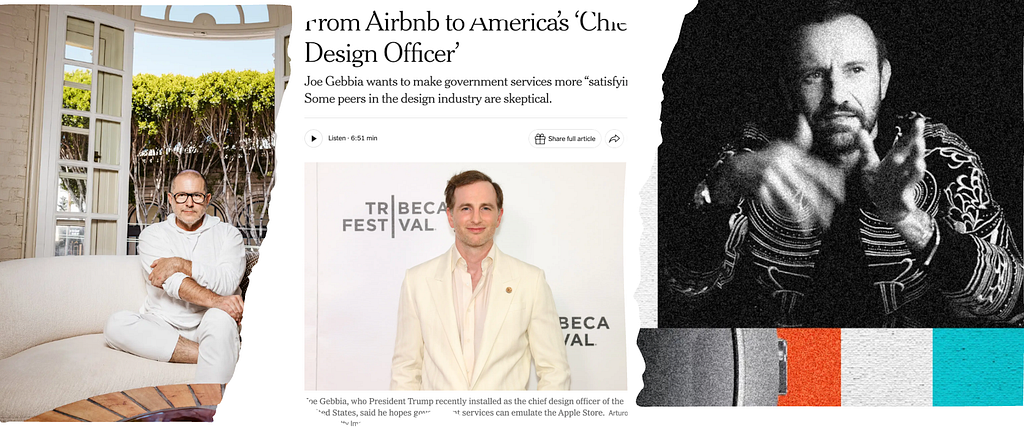
Something interesting has been happening in the background of all the AI hype, and I think it deserves more attention — especially after seeing Silke Bochat, Savannah College of Art and Design LinkedIn post.
While everyone is focused on models, benchmarks, and the race to build AI faster, some of the world’s largest technology companies are making a different bet: they’re elevating design.
- Microsoft recently appointed its first-ever Chief Design Officer.
- Samsung hired Mauro Porcini, the executive who previously established Chief Design Officer roles at both 3M and PepsiCo.
- Shopify revived a Chief Design Officer position that had been vacant for eight years and appointed Carl Rivera (now CPO at Nubank).
- Meta has been assembling an impressive design leadership bench, bringing in Alan Dye, formerly Apple’s Vice President of Human Interface Design, alongside Billy Sorrentino, a senior Apple design leader and former WIRED Creative Director.
- Even the US federal government has entered the conversation, creating a Chief Design Officer role and appointing Airbnb co-founder Joe Gebbia.
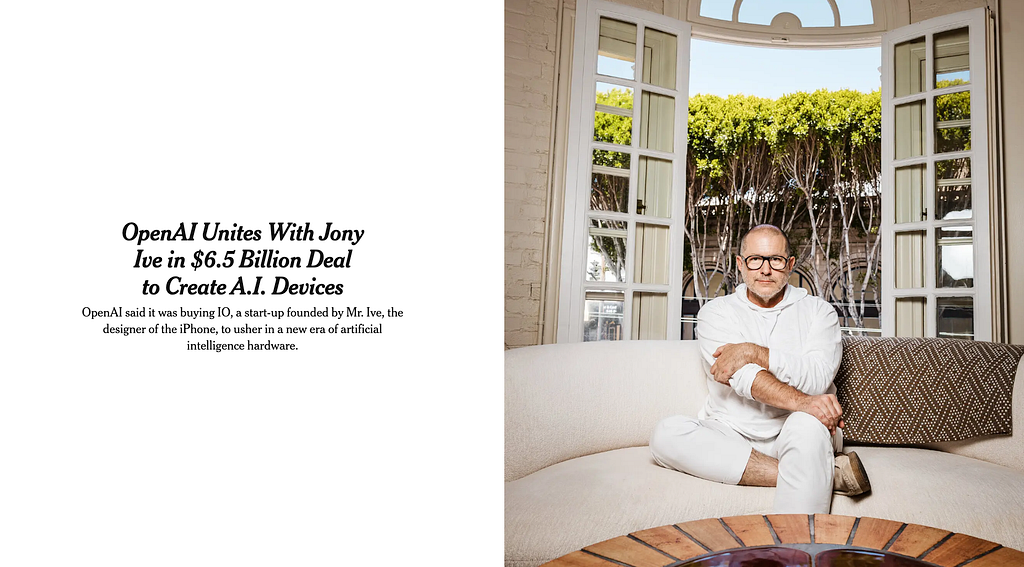
- OpenAI took a different approach. Rather than hiring a design leader, they effectively acquired one. Their $6.5 billion deal with Jony Ive and io feels less like a talent acquisition and more like buying into an entire design philosophy.
These aren’t simply new hires; they represent a deliberate effort to bring in talent, knowledge, and experience. The question is, why now?
For years, technology companies treated execution speed as a major advantage. Could you ship faster? Could you test faster? Could you scale faster? Could you out-build the competition?
That still matters. But AI changes the shape of the problem.
We can now generate interfaces, write code, create prototypes, produce content, analyse data, and automate workflows faster than at any previous point in software history. The cost of making something is falling. The speed of making something is rising.
But this creates a new problem.
When it becomes easier to build, it also becomes easier to build the wrong thing.
“We can now build the wrong things faster than ever before.”
Jon Friedman, new Chief Design Officer, Microsoft 365
As technology accelerates, the limiting factor is no longer our ability to build. Increasingly, technology can help create itself. The harder question is deciding what should be built and how it should fit into people’s lives. That is a human problem, and design sits at the center of answering it-Jon Friedman said.
Design is now the discipline of deciding what should be made, who it is for, what behaviour it encourages, what it removes, what it simplifies, and what kind of relationship it creates between people and technology.
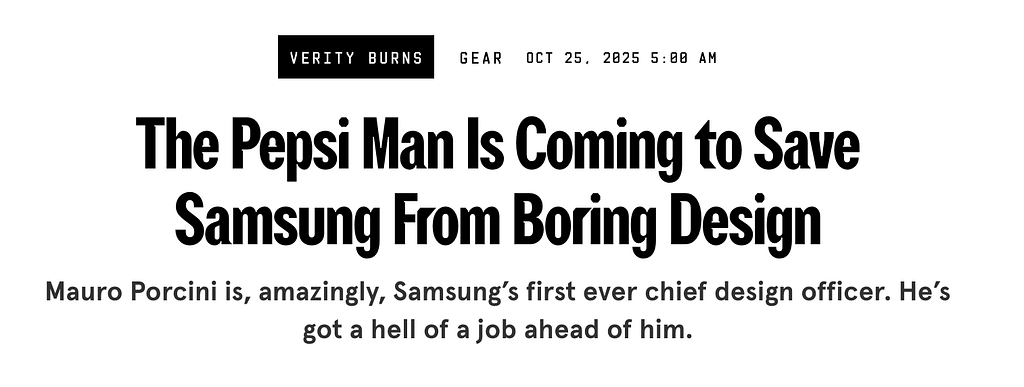
Samsung’s appointment of Mauro Porcini highlights the same shift. Rather than forcing visual consistency, Porcini is focused on creating consistent experiences across devices while using AI to personalise products around individual needs. The most successful companies increasingly win through the combination of hardware, software, services, and now AI working together as a coherent whole.
“We want to connect everything into one story, but creating the same design language in a mobile phone as in a refrigerator is very difficult,” he says. “Instead, the design story we want to tell is of a consistent experience across all our devices, alongside personalization and customization through the use of AI. I need to make sure I deliver to you the best refrigerator, the best mobile phone, the best television, that is perfect for you in your environment — we don’t want the visual language to constrain the possibility of delivering that.”
Mauro Porcini, President & Chief Design Officer — Samsung
The biggest misconception about AI products is that capability alone will determine adoption. It will not (NN/G, 2025).
There were touchscreen phones before the iPhone. Search engines before Google. E-commerce platforms before Shopify. Carl Rivera made this point when he reflected on Shopify’s next era: history does not necessarily remember the first version of a technology, but the first product that “felt right.” He called this “form x function fit” — the difference between potential and adoption.
Many AI products are impressive in demos but awkward in daily use. They can feel powerful but unpredictable. They can produce useful output but leave users unsure how much to trust them. They can save time in one moment and create review work in the next.
- Does the user understand what the AI is doing?
- Can they correct it?
- Can they control it?
- Can they trust it with sensitive information?
- Does it make them feel more capable, or more dependent?
- Does it improve the whole service experience, or does it simply add another layer of complexity?
These are design questions as much as engineering questions.
A badly designed AI workflow can make people feel like they are no longer in control. A poorly explained automation can damage trust faster than a traditional interface because the system appears to be making decisions.
This is why human-centred design becomes more valuable, not less, in the AI era.
Design is moving from execution to strategy
The pattern across Microsoft, Samsung, Shopify, Meta, OpenAI, and even government suggests a broader shift.
Design leaders are being asked to shape direction, not just output.
At Microsoft, Friedman’s role is connected to the challenge of creating more cohesive AI experiences across a company with enormous product scale. His article references early Copilot fragmentation as a lesson: simply attaching AI to existing products is not enough to create value. That is a very different design problem from improving a screen.
It is about deciding how AI should show up across a product ecosystem. It is about preventing dozens of teams from creating slightly different interaction models, language patterns, permissions, and expectations. It is about making a system feel understandable to the customer even when it is technically complex behind the scenes.
Samsung faces a similar challenge, but across an even broader mix of physical and digital products: phones, TVs, appliances, services, software, and AI-enabled experiences. In WIRED’s profile, Porcini argued that Samsung does not need to force the same visual language onto a refrigerator, a phone, and a television. Instead, the goal is to create a consistent experience across devices while allowing AI to support personalisation and context.
Consistency does not have to mean sameness. A fridge should not behave like a phone. A TV should not behave like a washing machine. But the experience across them can still feel like it comes from the same company, with the same values, the same level of care, and the same respect for the user’s environment.
This is where design becomes a connective discipline.
Design connects hardware, software, services, brand, research, business strategy, and customer experience. In the AI era, it also has to connect data, automation, personalisation, and trust.
That is too important to leave until the end.
The real product is the system around the interface
One of the traps product teams fall into is thinking the interface is the product.
The interface is where the user touches the product, but the experience is shaped by everything around it: onboarding, pricing, permissions, support, notifications, failure states, data policies, service handoffs, organisational incentives, and the user’s real-life context.
AI makes this even more obvious.
Imagine a small business owner using an AI tool inside an e-commerce platform. The value is not simply whether the AI can generate a product description. The value depends on whether the merchant trusts the suggestion, understands how it affects SEO, can edit it easily, knows whether it matches their brand voice, and feels confident publishing it.
Or think about a designer using an AI prototyping tool. The value is not only speed. It is whether the tool helps them think more clearly, explore better alternatives, communicate intent, and avoid creating generic work at scale.
Or consider a citizen trying to renew a passport or access benefits through a government website. The problem is not just visual design. It is language, accessibility, anxiety, eligibility rules, documentation, error recovery, and the emotional weight of dealing with a system that may affect their life.
This is why service design, research, content design, product strategy, and interaction design matter so much.
The winners in the AI era will not simply be the companies with the most advanced models. They will be the companies that turn capability into experiences people actually want to use.
Craft still matters
Average work becomes easier to produce. But that also means thoughtful work becomes more valuable.
Craft is not just visual refinement. It is the care behind the decision.
- It is noticing that a label creates anxiety.
- It is removing a step that should never have existed.
- It is choosing not to automate something because the user needs to remain in control.
- It is designing the empty state, the error state, the handoff, the permission moment, the cancellation flow.
- It is knowing when a product should speak and when it should stay quiet.
AI can help generate options, but craft helps decide which option has integrity.
This is especially important because AI products can easily become noisy. More prompts. More suggestions. More assistants. More summaries. More generated content. More things asking for attention.
Without strong design judgement, AI can turn products into cluttered systems full of technically impressive but emotionally exhausting features.
Design leaders are becoming alignment leaders
A single AI feature can involve product, engineering, data science, legal, privacy, brand, research, support, marketing, and policy. It may affect multiple surfaces and customer journeys. It may require new mental models for users and new operating models for teams.
Someone has to hold the experience together.
As a Service Designer, I see great value in understanding end-to-end experiences. While different teams own different touchpoints — from social media and onboarding emails to product access and multi-factor authentication — customers experience them as one journey. Design is uniquely positioned to connect these touchpoints and ensure the experience feels consistent and seamless.
This is especially powerful in service blueprint workshops, where the customer journey becomes the foundation for aligning teams around the work needed to deliver the service. When created collaboratively, a service blueprint becomes more than a map — it becomes a shared experience roadmap that teams can use to continuously monitor, improve, and evolve the experience as a whole.
This does not mean design should “own” everything. But design leaders are often well positioned to create alignment because the discipline naturally works across boundaries.
- Design asks: what is the user trying to do?
- Product asks: what should we build?
- Engineering asks: how can we make it work?
- Research asks: what do we know and what are we assuming?
- Brand asks: what promise are we making?
- Service design asks: what happens before, during, and after the interaction?
In healthy organisations, these questions inform each other.
The role of senior design leadership is increasingly to prevent that fragmentation. Not by controlling every decision, but by creating shared principles, clear experience standards, and a strong point of view about what the company is trying to make possible for people.
That is why the Chief Design Officer role matters.
It signals that design is not just a production capability. It is a strategic capability.
The takeaway
The companies that win will not be the ones that simply ship the most AI features. They will be the ones that create experiences people understand, trust, and return to.
Sources:
https://www.linkedin.com/pulse/proof-possibility-microsoft-design-qwqwc/ — very good blog post from Jon Friedman
https://www.nytimes.com/2025/08/27/style/joe-gebbia-trump-design-officer-airbnb.html
https://www.nngroup.com/articles/powered-by-ai-is-not-a-value-proposition/
Silke Bochat, Savannah College of Art and Design

While everyone talks about AI, design is gaining power was originally published in UX Collective on Medium, where people are continuing the conversation by highlighting and responding to this story.
This post first appeared on Read More