
What to Expect from the Definitive Java + Spring AI Series on Production MCP Engineering
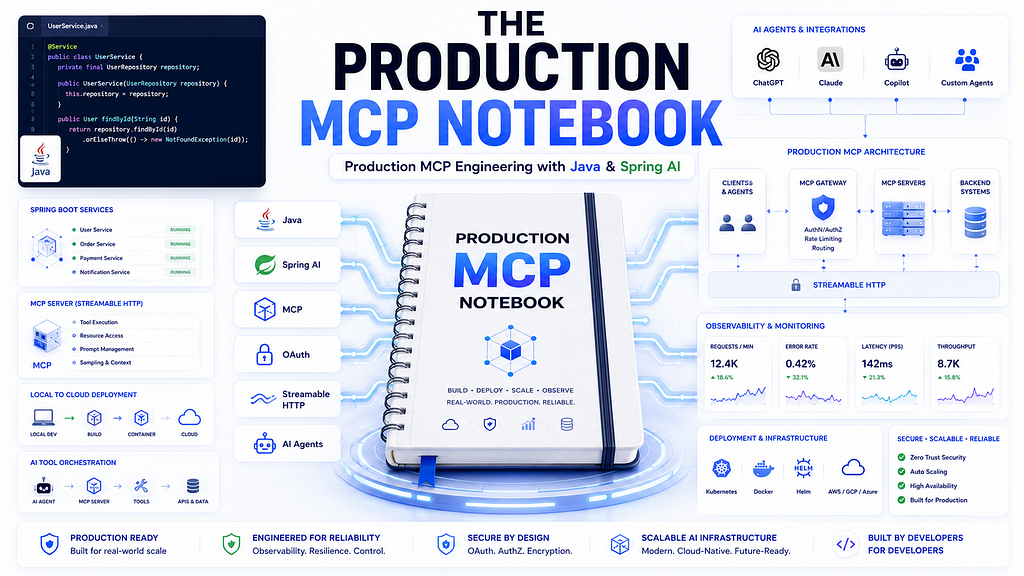
There is no shortage of MCP content on the internet. There is a serious shortage of MCP content written for the engineer who actually has to ship something — a real server, on a real domain, behind real auth, observed by a real on-call rotation, used by real users who do not care that the protocol is new. The Production MCP Notebook is the publication for that engineer. It’s a forty-plus article curriculum that takes you from your first Spring AI server through enterprise platform architecture, written in Java with Spring AI throughout, grounded in production engineering rather than tutorial code. This post is the map — what’s coming, in what order, and how to use it.
Who this is for
Java backend engineers, AI infrastructure architects, platform engineers, and senior developers who have decided to build MCP servers and want to do it once, correctly, at production grade. If you’ve shipped Spring Boot services before, you already have most of the prerequisites. The series assumes Java 21+, Spring Boot 3.x, comfort with Docker and Kubernetes for the later articles, and a working mental model of REST APIs and OAuth. It does not assume prior MCP knowledge.
If you’ve never built an MCP server before, the Beginner track gets you to a deployed, OAuth-protected, registry-published server in five articles. If you have, you can skip to the Intermediate track where the real production engineering starts.
What you’ll learn, by track
Beginner (5 articles) — Foundations. The mental model that separates MCP from REST. The three primitives (tools, resources, prompts) and when to use each. The transport decision (stdio, SSE, Streamable HTTP) and the mid-2026 SSE deprecation everyone needs to handle. End-to-end production deployment with OAuth 2.1, TLS, the /.well-known/oauth-protected-resource discovery document, and registry submission. Closing with an annotated code walkthrough of the Stripe MCP server — one of the best public examples of production MCP design.
By the end of the Beginner track, you’ll have a deployed Spring AI MCP server at a real domain with real authentication, plus the mental models to design tool catalogs that don’t fall apart in production.
Intermediate (12 articles) — Real production engineering. Tool schema design and the Six-Tool Pattern, with empirical evidence on why catalog size kills agent reliability. Writing tool descriptions that models actually pick correctly. Structured error envelopes that agents can recover from. OAuth 2.1 specifics including the RFC 8707 resource indicator requirements that prevent token-confusion attacks. Multi-tenancy patterns (path, header, subdomain) compared head-to-head. Rate limiting with cost-weighted budgets. The three layers of caching and the invalidation pitfalls each one creates. Idempotency for mutating tools. The REST-to-MCP anti-corruption layer pattern from Domain-Driven Design. The Streamable HTTP migration playbook for teams running legacy SSE servers. Database MCP servers using Postgres MCP Pro as the case study. Playwright MCP and the accessibility-tree-versus-screenshot decision.
This is the track where MCP servers stop being demos and start being services your platform team is comfortable operating.
Advanced (12 articles) — Production engineering and security. The full security arc: reproducing the Invariant Labs tool-poisoning attack and building the four-layer defense (install-time scanning, signed tool manifests, runtime description-pinning, output DLP). Rug-pull detection and signed manifests. Cross-server shadowing and the confused deputy problem. The MCP gateway pattern with a vendor-neutral comparative analysis of TrueFoundry, MintMCP, Descope, Red Hat’s Kuadrant-backed gateway, and Microsoft Foundry. Token translation at the gateway and the identity assertion grant pattern. Virtual MCP servers that expose two hundred tools without burning context windows. OpenTelemetry instrumentation for MCP with the GenAI semantic conventions. Cost attribution and chargeback models for multi-tenant deployments. Human-in-the-loop approval workflows for destructive actions. Tool versioning beyond the protocol version — the silent breakage problem and the pin-scope-test strategy. Stateless MCP servers designed for the 2026 spec. The audit log schema that satisfies SOC 2 and HIPAA.
This is the track that takes a working MCP server and makes it defensible, observable, and operable at scale.
Architect (8 articles) — Platform and governance. A reference architecture for enterprise MCP platforms. RBAC and the bounded-trust model. Build-versus-buy for MCP gateways with a three-year TCO comparison. Internal tool registries at enterprise scale, modeled on Microsoft Foundry’s catalog. Software supply chain security for MCP — treating tool definitions like npm packages. The seven-phase rollout playbook from POC to organization-wide deployment. Multi-agent coordination via MCP and where A2A takes over. The MCP capability maturity model.
This is the track for staff engineers, platform leads, and architects standing up MCP as an organizational platform.
Trend (8 articles) — Forward analysis. The 2026–07–28 spec release and what stateless core, the Tasks extension, and MCP Apps mean for your architecture. Server Cards and capability discovery without live connections. Event-driven MCP and triggers. The MCP skills and extensions model. MCP-native LLM models. WebAssembly MCP servers on the edge. The conformance test suite and what verifiable compliance means.
These run in parallel with the other tracks and keep the publication ahead of the curve as the spec evolves.
Why Java and Spring AI
Most MCP content online is written in TypeScript or Python. Both languages have excellent SDK support and both are appropriate choices. So is Java. The Java MCP ecosystem — Spring AI’s first-class MCP server starters, the community security module, the mature Spring Boot deployment story — is one of the strongest in production today, and almost no one is writing about it at depth.
Every article in this publication uses Java 21+ with Spring AI’s MCP server starters. The code is runnable. Maven coordinates are real. Configuration snippets work as shown. Sealed interfaces and records appear throughout because they’re the right Java pattern for structured tool results.
If you work in Java and you’ve been waiting for an MCP curriculum that doesn’t assume you’ll port everything from TypeScript yourself, this is the one.
How the articles are structured
Every article follows the same shape, because consistency makes the series easier to navigate:
A real production problem opens each piece — a team’s failure mode, a quantified cost, an incident that motivates the topic. Then the mental model: the framing that makes the rest of the article make sense. Then the implementation with runnable Spring AI code, dummy data included so the examples are self-contained. Then what production looks like at scale. Then the failure modes you’ll actually hit. Then security considerations specific to the topic. Then a “what didn’t work” section covering the patterns I’ve tried that failed and why. Then references — real ones, with links.
Articles publish every Tuesday and Friday. The Beginner track lands first, then Intermediate, then Advanced, then Architect, with Trend pieces running in parallel as the spec evolves.
How to read this series
Three paths work, depending on where you’re starting.
If you’re new to MCP entirely, read the Beginner track in order, then continue into the Intermediate track. The articles build on each other — concepts from earlier pieces show up assumed in later ones.
If you’ve shipped an MCP server before and want to harden it, skip to the Intermediate track. Start with the Six-Tool Pattern article, then the structured errors piece when it lands, then the OAuth 2.1 article. These three together represent the most leverage per hour of reading.
If you’re a platform engineer or architect evaluating MCP for your organization, read the Stripe MCP walkthrough from the Beginner track for production patterns, then jump to the Advanced and Architect tracks as those articles publish. The reference architecture piece will be the canonical link you share with your team.
What you can do today
If you want to follow along:
Subscribe to The Production MCP Notebook on Medium to get articles in your feed every Tuesday and Friday.
The bet
MCP is the protocol that’s going to connect a generation of enterprise systems to language models. The teams that ship MCP servers carefully — with good catalog design, real security, observable infrastructure, and platform-grade operational discipline — are going to be the ones whose AI deployments work. The teams that ship them carelessly are going to be the ones cleaning up incidents, paying for token waste, and explaining to security teams how their MCP server became a data exfiltration vector.
The Production MCP Notebook exists for the first group. The publication is six months of work compressed into a curriculum you can read in your commute. If you’re going to build MCP servers for a living, this is the reference series I wish existed when I started.
See you Tuesday.
If you found this useful, a clap helps other engineers find it. Follow The Production MCP Notebook for new articles every Tuesday and Friday — we’re building the canonical reference for production MCP servers, from your first Spring AI server through enterprise gateway architecture. Got a pattern you want to see covered? Leave a response — reader questions drive the roadmap.

Introducing The Production MCP Notebook : The 6-Month Curriculum was originally published in Javarevisited on Medium, where people are continuing the conversation by highlighting and responding to this story.
This post first appeared on Read More