
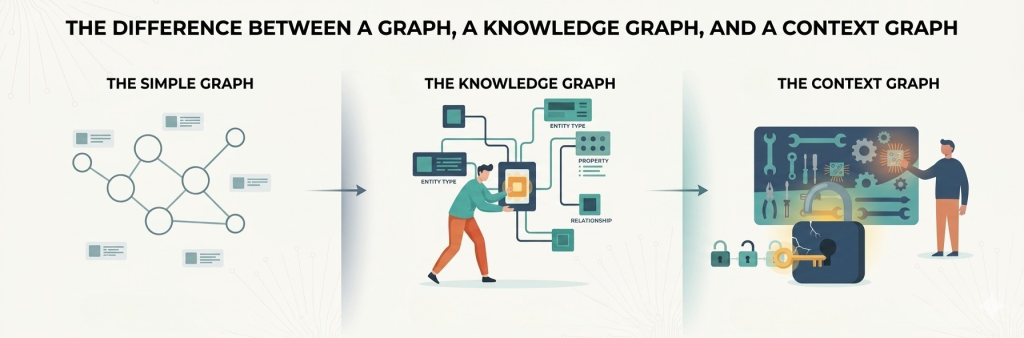
This is part 1 of a three-part series on the evolution from graphs to knowledge graphs to context graphs and why connected data is becoming foundational for enterprise AI. In this series, I’ll look at what these terms mean, why they matter to customers, and how the broader partner ecosystem can help bring contextual AI into production.
There has been an explosion in the number of terms we’re hearing in the AI and data world: graph, knowledge graph, context graph, GraphRAG, agent memory, semantic layer, and connected intelligence.
For business leaders and marketers, it can feel like the terminology is advancing faster than the technology is developing.
But the distinction between the graph terms and technologies matters, especially as organizations move from AI experimentation to production. Each concept builds on the one before it, and together they explain why connected data is becoming so important in the age of AI.
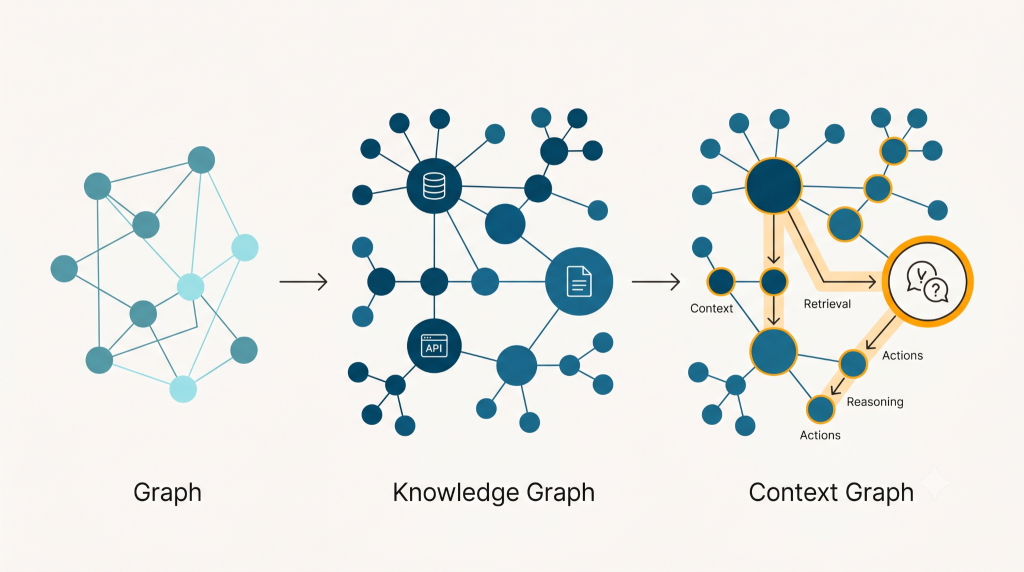
A Graph
A graph is a way to represent data and its relationships.
Instead of organizing data in rows and columns, a graph models entities such as customers, accounts, products, suppliers, transactions, employees, or devices, and importantly, the relationships between them. All of which are easily missed in a rows-and-columns approach.
A graph helps business teams answer questions like:
- Which customers, accounts, products, suppliers, or transactions are connected in ways we should pay attention to?
- Where are there hidden risks, opportunities, or dependencies across the business?
- What patterns can help us make better decisions, faster?
- How can we see the full picture instead of looking at each system, record, or interaction in isolation?
A Knowledge Graph
A knowledge graph builds on a graph by adding organization and meaning.
A knowledge graph does not just show that two things are connected: It helps define what those things are, what the relationship means, and how they fit into a larger business context. For example, where a graph may show that a person is connected to a company, a knowledge graph can help explain that the person is an employee, the company is a supplier, the supplier belongs to a regulated industry, and the relationship may matter for compliance, risk, or customer service.
In other words, a knowledge graph helps answer the question: What do these connections mean?
A Context Graph
A context graph takes the next step by making the right knowledge available when it is needed.
Using the same example, a context graph would not only know that a person works for a regulated supplier, it could help determine why that relationship matters in a specific moment. For example, if an AI assistant is helping a procurement team review a new contract, the context graph could surface that the supplier operates in a regulated industry, that the team member has approval authority, that there were past compliance issues, and that certain policies apply before the contract can move forward.
That is the difference: the knowledge graph defines the meaning of the relationship; the context graph helps apply that meaning to the task at hand.
Context graphs are especially important for AI. Generative AI systems and agents need more than data; they need the right context for a specific user, task, workflow, question, or decision. A context graph can include business knowledge, user intent, permissions, history, current state, and relevant relationships.
In other words, a context graph helps answer: What matters right now?
You may also hear the term GraphRAG in this conversation. GraphRAG, or graph-based retrieval-augmented generation, is one way organizations can use graph technology to improve generative AI. Instead of retrieving isolated documents or chunks of text, GraphRAG can help AI systems retrieve connected, relevant context from across relationships in the data. In that sense, GraphRAG is not a separate category from graphs, knowledge graphs, or context graphs. It is one way to put them to work for AI.
Simple Comparison Table
| Concept | Simple Definition | Helps Answer |
| Graph | Connects entities and relationships | What is connected? |
| Knowledge Graph | Adds meaning and business context | What do the connections mean? |
| Context Graph | Delivers relevant context for a task, decision, or AI system | What matters right now? |
Understanding the terminology is useful, but the bigger question is around why it matters.
In the next post, I’ll look at why graphs, knowledge graphs, and context graphs are becoming more important to customers, especially as organizations move from AI experiments to production systems that need accuracy, relevance, explainability, and trust.
This article first appeared on Read More