
Hello folks, I’ve prepared for hundreds of technical interviews across my 20-year software engineering career.
But system design interviews? Those destroyed me.
It wasn’t that I lacked experience. I’ve architected large-scale systems. I’ve optimized databases. I’ve dealt with real infrastructure problems.
The issue was different: Most resources taught me what to design, not how to think about design.
I could memorize “use a load balancer here” and “add caching there.” But when an interviewer changed constraints or asked follow-up questions, I’d freeze. My memorized architectures didn’t adapt.
I knew something was broken in my preparation approach.
So I started testing resources. Udemy courses. Coursera specializations. Books. YouTube channels. Nothing quite worked until I discovered ByteByteGo.
And honestly? It changed how I think about system design entirely.
The Problem That Started Everything
Let me set the stage.
I was preparing for a senior engineer role at a major tech company. The job posting explicitly mentioned “strong system design skills required.”
I thought I was ready. I’d shipped production code at scale. I understood databases, caching, message queues.
Then I did a mock interview.
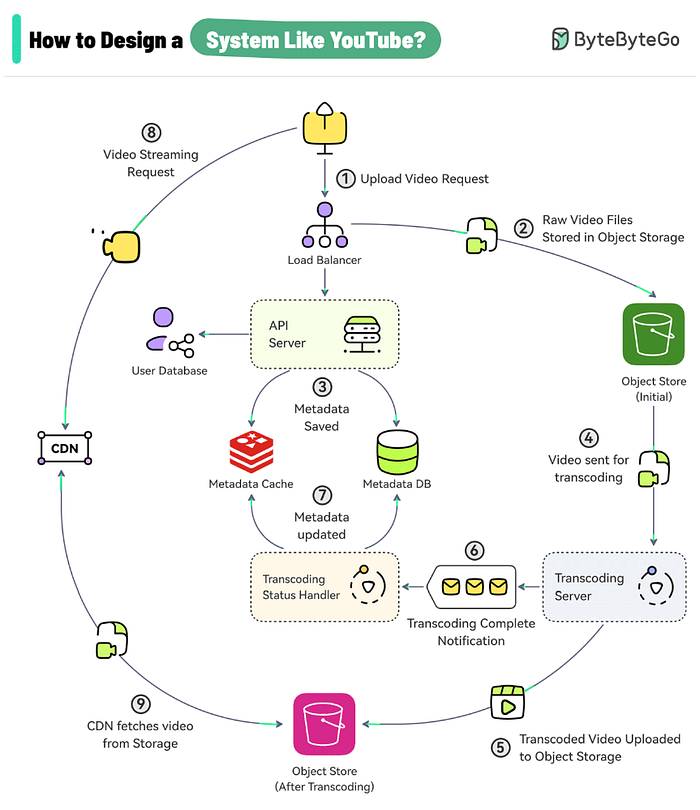
The interviewer asked: “Design a system for video streaming.”
I started drawing load balancers, database clusters, CDN architecture. Standard stuff.
Then he asked: “What if we need to optimize for bandwidth in developing countries?”
My memorized answer broke. My architecture wasn’t flexible. I started adding more components instead of reconsidering my approach.
I failed that mock interview badly.
That’s when I realized: I had architectural knowledge, but I didn’t have architectural thinking.
Finding ByteByteGo (By Accident)
I first encountered ByteByteGo while scrolling Twitter two years ago.
Alex Xu (the founder) posted a diagram explaining how HTTPS works. Just a visual explanation — nothing fancy.
But something clicked. The diagram was clear. It showed flow. It explained concepts visually instead of with walls of text.
I clicked through to his platform and was immediately impressed.
Unlike other resources that teach you what, ByteByteGo teaches you how to think.
I signed up for their lifetime plan and committed to working through their system design content systematically.
That was the decision that changed my interview performance.
What I Actually Found?
Here are few things which are worth highlighting :
1. Visual Learning That Actually Works
The biggest difference from other resources: Everything is visual.
Instead of reading paragraphs about load balancing, I saw:
- Diagrams showing how requests flow
- Step-by-step visual explanations
- Progressive refinement (starting simple, then adding complexity)
This mattered more than I expected. In interviews, you’re drawing on a whiteboard. You need to think visually.
ByteByteGo trains you to think in diagrams, not in text. That skill translated directly to interviews.
Examples of their visual content:
A framework for system design interviews
When I watched these, I wasn’t memorizing answers. I was learning to think like an architect.
2. Going Deep, Not Just High-Level
I expected ByteByteGo to be surface-level: “Here’s a cache, here’s a database.”
It wasn’t.
They go deep into:
- Scalability and capacity planning
- Data consistency models (eventual vs. strong)
- Caching strategies (cache invalidation, warming, etc.)
- Load balancing algorithms
- Trade-offs explicitly explained
And they connect everything to their book series by Alex Xu:
System Design Interview — An Insider’s Guide (Vol 1)
System Design Interview — An Insider’s Guide (Vol 2)
What impressed me: The content didn’t replace the books. It enhanced them. The books gave depth; ByteByteGo made that depth visual and interactive.
System Design · Coding · Behavioral · Machine Learning Interviews
3. Coding Interview Patterns (The Hidden Superpower)
Here’s what surprised me most: Most platforms treat system design and coding interviews as separate skills.
ByteByteGo connects them. They teach Coding Interview Patterns alongside system design.
Why? Because interviews test both. You need to:
- Choose right data structures
- Write clean code
- Explain time/space trade-offs
Their pattern-based approach was revelatory:
Instead of random problem collections, they organize by patterns. “Two pointers,” “sliding window,” “binary search,” etc.
This pattern recognition made me significantly faster at recognizing problem types in interviews. It pairs perfectly with:
Coding Interview Patterns: Nail Your Next Coding Interview
I went from taking 10 minutes to recognize a pattern to spotting it in 30 seconds. That speed matters in interviews.
Coding Interview Patterns: Nail Your Next Coding Interview
4. Object-Oriented Design (My Weakest Area)
Before ByteByteGo, I struggled with OOP design interviews.
Designing a “Parking Lot” or “Elevator System” felt disconnected from real engineering. I didn’t take it seriously.
Big mistake.
Interviewers use OOP design to test:
- Abstraction thinking
- SOLID principles
- Class relationships
- Extensibility
I was failing these interviews because I hadn’t practiced thinking architecturally about object-oriented design.
ByteByteGo has dedicated content:
What is an OOP design interview
After working through their OOP section, these interviews became straightforward. Not because I memorized answers, but because I understood how to think about object design.
This aligns with:
Object-Oriented Design Interview: An Insider’s Guide
Object Oriented Design Interview: An Insider’s Guide
5. Machine Learning System Design (Increasingly Critical)
In 2026, many system design interviews for any backend role include ML components.
This caught me off-guard. My first few interviews asked about recommendation systems and search algorithms — areas I hadn’t studied.
ByteByteGo has an entire section on ML system design:
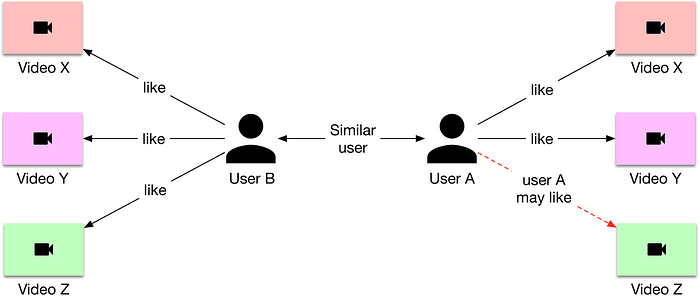
What I appreciated: They focus on end-to-end ML systems, not just model training.
How do you collect data? How do you serve predictions at scale? How do you handle feedback loops?
This complements:
Machine Learning System Design Interview
Machine Learning System Design Interview
6. Generative AI System Design (Future-Proofing)
The final piece that impressed me: Generative AI System Design.
As someone preparing for 2026 interviews, I knew GenAI would come up. And it did.
I got asked: “Design a system for LLM-powered question answering.”
Because I’d studied ByteByteGo’s GenAI section, I could think through:
- Prompt pipelines
- RAG architecture
- Token optimization
- Real-world trade-offs
Explore it here:
Generative AI System Design interview
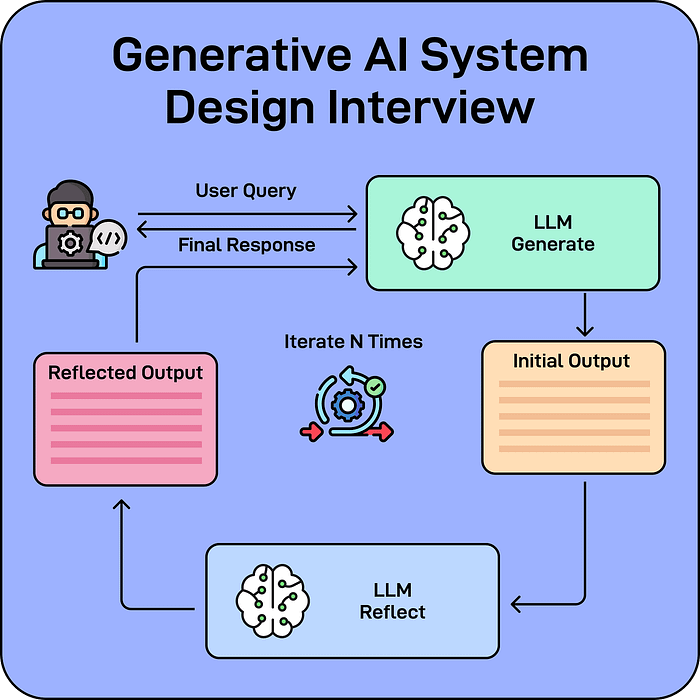
This aligns with:
Generative AI System Design Interview
Very few platforms cover GenAI system design at this depth. ByteByteGo is probably the best for interview preparation specifically.
How It Actually Improved My Interview Performance?
Let me be concrete about the impact.
Before ByteByteGo:
- Mock interviews: 40–50% success rate
- Time to answer design questions: 30+ minutes
- Struggling with follow-ups
- Weak OOP design and ML system design
After 8 weeks of systematic ByteByteGo study:
- Mock interviews: 85–90% success rate
- Time to answer design questions: 12–15 minutes
- Confidently handling constraint changes
- Strong across all interview types (system design, coding, OOP, ML)
The difference wasn’t just knowledge. It was thinking style.
I stopped memorizing architectures and started understanding principles. When interviewers asked unusual questions, I could adapt instead of panicking.
The Value Proposition (And The Current Discount)
ByteByteGo offers both annual and lifetime plans.
Interview prep isn’t one-time. You revisit these concepts:
- Before job changes
- During promotions
- When mentoring others
- When learning new technologies
That’s why I chose the lifetime plan. Once purchased, it’s yours forever.
Currently, ByteByteGo is offering up to 50% off on both annual and lifetime plans.
You can also use code JALJAD for an additional 10% discount.
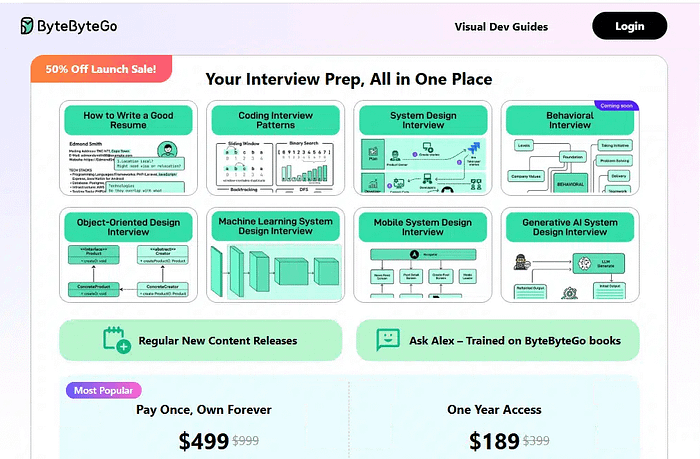
Let me break down the ROI:
Without ByteByteGo:
- Scattered preparation across multiple courses
- Wasted time on resources that don’t teach thinking
- Potentially multiple failed interviews
- Extended job search process
With ByteByteGo (lifetime):
- Single, comprehensive resource
- Structured learning path
- Confidence in interviews
- Potentially landing a job faster
One extra 10% salary bump in your next role pays for years of access.
Check the pricing and discount here
What Didn’t Work as Well
To be fair, ByteByteGo isn’t perfect:
1. Video-heavy format Some people prefer reading. The content is very visual/video-first, which might not suit everyone.
2. Requires active engagement You can’t passively watch and learn. You need to pause, think about diagrams, work through design exercises.
3. Not a complete interview prep platform For behavioral interviews, you might want to supplement with Exponent or similar. ByteByteGo focuses on technical interviews.
4. Coding interview content is organized by pattern, not by problem difficulty If you want a “LeetCode hard” level problem, you need to hunt through the pattern sections.
These are minor issues. The strengths far outweigh the weaknesses.
My honest take: If you’re preparing for system design interviews specifically, ByteByteGo is the single best resource available.
If you’re preparing for complete tech interviews (coding + system design + behavioral), combine ByteByteGo + Exponent + AlgoMonster.
Final Thoughts
ByteByteGo didn’t just help me prepare for interviews. It changed how I think about architectural problems.
The visual explanations stuck. The pattern-based approach made me faster. The comprehensive coverage meant I could face any interview question confidently.
Most importantly, I moved from “memorizing answers” to “understanding principles.”
That difference is everything in technical interviews.
If you’re preparing for system design interviews in 2026, especially for senior roles, ByteByteGo is genuinely one of the best investments you can make.
Getting Started
Step 1: Browse their free content to get a feel: ByteByteGo
Step 2: Check the current pricing (50% off): ByteByteGo Pricing
Step 3: Use code JALJAD for additional 10% off
Step 4: Start with their system design framework, then progress through topics based on your interview timeline
Step 5: Supplement with mock interviews (try Exponent) to get feedback on your explanations
In 6–8 weeks of systematic study, you’ll see dramatic improvement in your interview performance.
Trust me on this one.
P.S. — If you’re preparing for system design interviews in the next few months, there’s no better time to start than now. The 50% discount is rare. The lifetime plan means you get updates forever.
Just go sign up for ByteByteGo and commit 6–8 weeks to systematic preparation. The ROI on your next engineering role will be worth it 10x over.
System Design · Coding · Behavioral · Machine Learning Interviews
Good luck with your interviews! 🎯

I Tried ByteByteGo for System Design Interview and It’s Awesome was originally published in Javarevisited on Medium, where people are continuing the conversation by highlighting and responding to this story.
This post first appeared on Read More